Can You Claim Health Insurance on Your Taxes in Canada?
Health care costs in Canada can add up quickly, and many Canadians wonder whether the premiums they pay for health, dental, vision, or supplemental insurance can be claimed on their tax return. The answer is yes, in certain situations. This guide explains the CRA rules so you know exactly when and how to claim health insurance on your taxes.
Is Health Insurance Directly Tax Deductible in Canada?
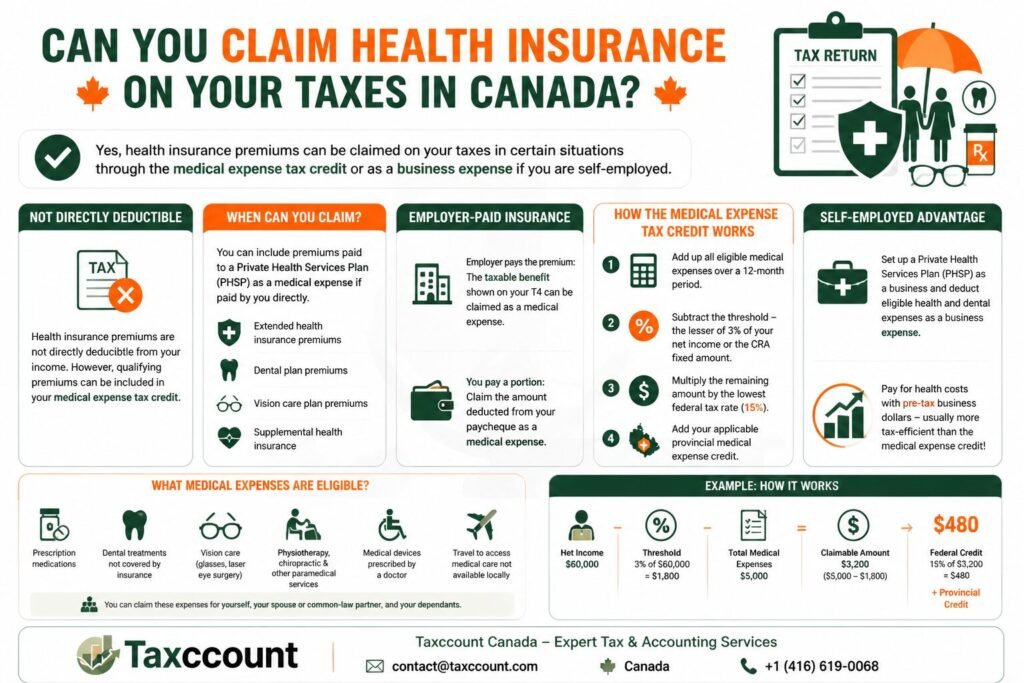
Health insurance premiums are not directly deductible as a line item on your personal income tax return. You cannot simply subtract your premiums from your income the way you deduct RRSP contributions. However, qualifying premiums can be included as part of your medical expense tax credit, which reduces the tax you owe.
Claim Health Insurance
☎️ Get HelpWhen Can You Claim Health Insurance Premiums?
You may be able to include your health insurance premiums as a medical expense if they are paid to a Private Health Services Plan (PHSP). A PHSP is a plan that covers medical, dental, or hospital expenses and meets the CRA’s definition.
Common examples of qualifying PHSP premiums include:
- Premiums you pay out of pocket for extended health coverage
- Premiums for dental plans you purchased privately
- Vision care plan premiums paid directly by you
- Supplemental health insurance not covered by provincial health plans
To be eligible, the premiums must be paid by you directly, not reimbursed by your employer or another plan.
Employer-Paid Health Insurance: What You Can Claim
If your employer pays your group health insurance premiums, those premiums are generally considered a taxable benefit and may appear on your T4 slip. You can then include that taxable benefit amount as a medical expense on your tax return, because you effectively paid tax on it.
If your employer deducts a portion of the premium from your paycheque, you can claim your own contribution as a medical expense.
How the Medical Expense Tax Credit Works
The medical expense tax credit is a non-refundable federal credit that reduces your tax payable. Here is how it is calculated:
- Add up all eligible medical expenses over a 12-month period ending in the current tax year.
- Subtract the threshold, which is the lesser of 3% of your net income or the fixed dollar amount set by the CRA each year.
- Multiply the remaining amount by the lowest federal tax rate (15%).
- Add your applicable provincial medical expense credit.
For example, if your net income is $60,000, your threshold is $1,800 (3% of $60,000). If your total qualifying medical expenses, including health insurance premiums, are $5,000, you can claim $3,200. The federal credit would be $480 (15% of $3,200), plus any provincial credit.
Self-Employed Canadians: A More Powerful Option
If you are self-employed, you have a more tax-efficient option. You can set up a Private Health Services Plan (PHSP) as a business and deduct eligible health and dental expenses as a business expense rather than claiming the medical expense credit. This allows you to pay for health costs with pre-tax business dollars, which is generally more valuable than a non-refundable tax credit.
The CRA has specific rules around how a PHSP must be structured for the self-employed. Consulting a tax professional can help you set this up correctly and maximize your tax savings.
What Medical Expenses Are Eligible?
In addition to qualifying health insurance premiums, the following are among the many medical expenses that can be claimed as part of the medical expense tax credit:
- Prescription medications
- Dental treatments not covered by insurance
- Vision care, including glasses and laser eye surgery
- Physiotherapy, chiropractic, and other eligible paramedical services
- Medical devices prescribed by a doctor
- Travel expenses to access medical care not available locally
These expenses can be claimed for yourself, your spouse or common-law partner, and your dependent children under 18.
Table of Summary
Here is the blog information in 6 easy rows for quick understanding:
| Section | Easy Information |
|---|---|
| 1. Topic | The blog explains claiming health insurance premiums on Canadian taxes and when they are eligible. |
| 2. Deductibility | Health insurance premiums are not directly deductible, but can be claimed through the medical expense tax credit. |
| 3. Eligible PHSP Premiums | Includes premiums paid out of pocket for extended health, dental, vision, or supplemental insurance. Employer-paid portions are taxable benefits but can sometimes be included if you paid tax on them. |
| 4. How the Tax Credit Works | Add all eligible expenses over 12 months, subtract 3% of net income or CRA threshold, multiply remaining amount by 15%, and add provincial credits. |
| 5. Self-Employed Option | Self-employed individuals can set up a Private Health Services Plan as a business and deduct eligible premiums as a business expense, which is more valuable than a non-refundable credit. |
| 6. Other Eligible Medical Expenses | Prescription medications, dental/vision care, physiotherapy, paramedical services, medical devices, and travel for medical care. |
Frequently Asked Questions
Can I claim my monthly health insurance premium on my taxes?
Yes, if you paid the premiums yourself and the plan qualifies as a Private Health Services Plan. Include the premiums as part of your medical expense tax credit when filing your T1 return.
Can I claim my employer’s health plan if the premiums are on my T4?
Yes. If your employer-paid premiums are shown as a taxable benefit on your T4, you can include that amount as a medical expense on your return.
Is it worth claiming health insurance as a medical expense?
It depends on your total eligible medical expenses and income. The medical expense credit only applies above the 3% threshold, so low expenses relative to income may not yield a significant credit. However, combining all eligible expenses including premiums often makes it worthwhile.
Can self-employed people deduct health insurance premiums?
Yes. Self-employed individuals can set up a qualifying PHSP and deduct eligible health and dental costs as a business expense, which is generally more tax-efficient than the medical expense credit.
Want to maximize your medical expense claims and reduce your tax bill?
Taxccount helps Canadians identify every eligible medical expense, health insurance premium, and tax credit they qualify for. Book a free consultation with Taxccount today and make sure you are claiming everything you are entitled to.
Maximize Medical Tax Credit
☎️ Get HelpThis is general information only and not professional advice. Consult a professional before acting.
 Written and fact-checked by Udit Gupta
 Written and fact-checked by
 Ex Big4, Ernst & Young, Deloitte | International & Cross-Border Tax Specialist | CPA Canada In Depth Tax Training | Licensed Chartered Accountant from ICAI & MIA
Udit Gupta has over 15 years of experience helping corporations & business owners with corporate structuring, corporate tax filing, bookkeeping, payroll, GST/HST, cross-border tax and CRA representation. Big 4 trained at Ernst & Young and Deloitte, and qualified as a Chartered Accountant in India and Malaysia, he founded accounting firm in 2014 to serve entrepreneurs, startups and non-resident business owners across Canada. View Full Member Bio.
Indian Institute of Chartered Accountant Member No. (521458) | Malaysian Institute of Accountants Membership number (CA 44667) | Ex Big4,Ex Ernst & Young (EY), Ex-Deloitte | CPA Canada In-Depth Tax Training 19 Dec 2023, 12 Jul 2022, 5 Jul 2023
Editorial policy. Every article is researched against primary sources — the Income Tax Act, CRA publications and CPA Canada.