Tax Credits vs. Tax Deductions in Canada: What Is the Difference?

When Canadians hear about ways to reduce their taxes, two terms come up repeatedly: tax credits and tax deductions. Many people use these terms interchangeably, but they are not the same thing. They work differently, and understanding the distinction can change how you approach your tax planning.
This guide explains both concepts in plain language, gives examples of each, and helps you understand which one provides a bigger benefit in different situations.
What Is a Tax Deduction?
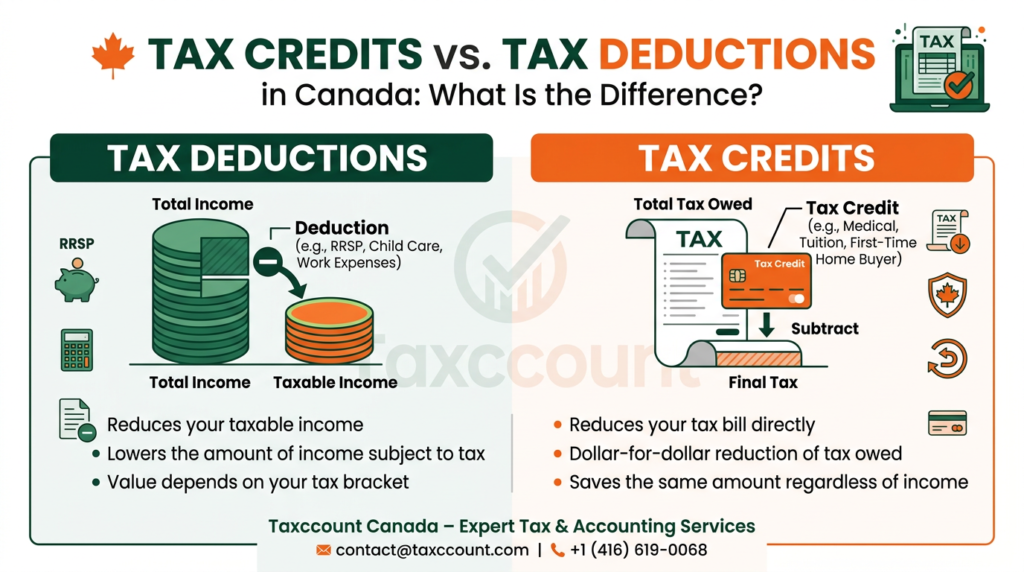
A tax deduction reduces your taxable income. It is subtracted from your total income before the government calculates how much tax you owe.
Here is a simple example:
- Your total income is $80,000
- You have a deduction of $10,000 (for example, an RRSP contribution)
- Your taxable income becomes $70,000
- The government calculates your tax based on $70,000, not $80,000
The value of a deduction depends on your marginal tax rate. The higher your income, the more a deduction saves you.
Let Taxccount review your return
☎️ Get HelpFor example, if your marginal rate is 40% and you claim a $10,000 deduction, you save $4,000 in tax. If your marginal rate is 20%, the same $10,000 deduction saves you only $2,000.
What Is a Tax Credit?
A tax credit reduces the amount of tax you owe directly. It is applied after your tax is calculated, not before.
Here is how it works:
- Your taxable income is $70,000
- Your calculated federal tax is $12,000
- You have a $2,000 tax credit
- Your actual tax owing is reduced to $10,000
Unlike deductions, the value of a tax credit is the same for everyone who claims it — it reduces your tax by the same dollar amount regardless of your income bracket.
Refundable vs. Non-Refundable Credits
There are two types of tax credits in Canada:
1. Non-Refundable Tax Credits
These can reduce your tax to zero, but they cannot generate a refund. If the credit is larger than your tax owing, the excess is simply lost.
Examples include:
- Basic Personal Amount
- Age Amount
- Disability Tax Credit
- Tuition Tax Credit
- Caregiver Amount
2. Refundable Tax Credits
These can reduce your tax below zero, meaning the government pays you the difference as a refund even if you owe no tax at all.
Examples include:
- GST/HST Credit
- Canada Workers Benefit
- Ontario Trillium Benefit
- Refundable Medical Expense Supplement
Refundable credits are particularly valuable for lower-income Canadians who may not have much tax owing.
Key Differences Between Credits and Deductions
Here is a side-by-side comparison:
Tax Deduction:
- Reduces your taxable income
- Benefit depends on your marginal tax rate
- Higher earners benefit more from the same deduction
- Applied before tax is calculated
Tax Credit:
- Reduces your tax owing directly
- Same benefit for everyone (for non-refundable credits, this is a flat percentage)
- Can benefit lower earners as much as higher earners
- Applied after tax is calculated
Examples of Common Deductions in Canada
- RRSP contributions: Reduces your taxable income dollar for dollar
- Union dues: Reduces employment income
- Childcare expenses: Deducted from income
- Moving expenses: Deducted from income earned at new location
- Business expenses (self-employed): Reduces net business income
- Home office expenses for employees: Reduces employment income
Examples of Common Tax Credits in Canada
Federal non-refundable credits:
- Basic Personal Amount: Everyone gets this; it offsets the tax on approximately the first $15,705 of income
- Canada Caregiver Credit: For those supporting a dependent with an impairment
- Medical Expense Tax Credit: 15% of eligible medical expenses above a threshold
- Disability Tax Credit: For those with severe and prolonged impairments
- Tuition Tax Credit: 15% of eligible tuition paid to qualifying institutions
- Age Amount: For Canadians 65 and older
Provincial credits vary by province and can add meaningfully to your total tax savings.
Which Saves You More Money?
It depends on your situation.
Deductions are more valuable for higher earners. If you are in a 45% marginal tax bracket, a $10,000 deduction saves $4,500. The same deduction saves a person in a 20% bracket only $2,000.
Credits provide equal or targeted support regardless of income. A $1,500 non-refundable credit saves everyone $1,500 in tax, regardless of income level. Refundable credits provide even more support to lower-income individuals.
For most Canadians, using both is the key. RRSP deductions help high earners reduce taxable income, while credits like the Basic Personal Amount, Canada Workers Benefit, and medical expense credit reduce the actual tax owed.
Table of Summary
| Topic | Key Information |
|---|---|
| Tax Credits vs. Tax Deductions | Tax deductions reduce taxable income, while tax credits directly reduce the amount of tax owed. Understanding the difference helps Canadians plan their taxes and identify potential savings. |
| What Is a Tax Deduction? | A tax deduction is subtracted from total income before tax is calculated. It lowers taxable income and can reduce the amount of tax payable. |
| Example of a Tax Deduction | If your income is $80,000 and you claim a $10,000 deduction, your taxable income becomes $70,000 before other applicable adjustments. |
| How Marginal Tax Rates Affect Deductions | The value of a deduction depends on your marginal tax rate. A $10,000 deduction saves $4,000 at a 40% marginal rate but saves $2,000 at a 20% rate. |
| What Is a Tax Credit? | A tax credit reduces the tax calculated on your income. It is applied after tax is calculated rather than reducing taxable income. |
| Example of a Tax Credit | If your calculated federal tax is $12,000 and you qualify for a $2,000 tax credit, your federal tax payable may be reduced to $10,000, subject to the credit’s rules. |
| Value of Tax Credits | The value of a credit depends on its type. For example, many federal non-refundable credits are calculated using a prescribed rate, commonly 15%, rather than reducing tax by the full stated amount of eligible expenses. |
| Non-Refundable Tax Credits | These credits can reduce tax payable to zero but generally cannot create a refund on their own. Any unused amount is usually lost unless specific transfer or carryforward rules apply. |
| Examples of Non-Refundable Credits | Common examples include the Basic Personal Amount, Age Amount, Disability Tax Credit, Tuition Tax Credit, and Canada Caregiver Credit. |
| Refundable Tax Credits | Refundable credits can provide a payment even when the recipient has no income tax payable. The eligible amount may be paid as a refund, subject to program requirements. |
| Examples of Refundable Credits | Examples include the GST/HST Credit, Canada Workers Benefit, Ontario Trillium Benefit, and Refundable Medical Expense Supplement for eligible individuals. |
| Tax Deductions: Key Features | Deductions reduce taxable income, are applied before tax is calculated, and generally provide greater savings to individuals with higher marginal tax rates. |
| Tax Credits: Key Features | Credits reduce tax payable directly. Their value depends on whether they are refundable or non-refundable and on the specific calculation rules for each credit. |
| RRSP Contributions | Eligible RRSP contributions can be deducted from taxable income, subject to contribution limits and applicable rules. The tax savings depend on the individual’s marginal tax rate. |
| Union Dues | Eligible union dues may be deducted from employment income, reducing taxable income. |
| Childcare Expenses | Eligible childcare expenses may be deducted from income, subject to CRA rules and applicable limits. |
| Moving Expenses | Qualifying moving expenses may be deductible when the move meets the applicable distance and work- or study-related requirements. |
| Self-Employed Business Expenses | Eligible business expenses reduce net business income, which can lower taxable income. Expenses must meet the applicable tax requirements. |
| Employee Home Office Expenses | Eligible employees may be able to deduct qualifying home office expenses if they meet the applicable CRA conditions. |
| Basic Personal Amount | The Basic Personal Amount is a non-refundable tax credit, not a deduction. It helps reduce federal tax on a portion of an individual’s income. The amount can change by tax year and income level. |
| Canada Caregiver Credit | This non-refundable credit may be available to eligible individuals supporting a dependent with a physical or mental impairment. |
| Medical Expense Tax Credit | The Medical Expense Tax Credit is generally calculated using eligible medical expenses above the applicable income-based threshold. The federal credit commonly uses a 15% rate, subject to the rules. |
| Disability Tax Credit | The Disability Tax Credit is a non-refundable credit for eligible individuals with severe and prolonged impairments who meet CRA requirements. |
| Tuition Tax Credit | Eligible tuition paid to qualifying educational institutions may qualify for a non-refundable tax credit. The federal credit is generally calculated at 15% of eligible tuition amounts. |
| Age Amount | Eligible Canadians aged 65 or older may qualify for the Age Amount, a non-refundable credit subject to income limits and other requirements. |
| Provincial and Territorial Credits | Provincial and territorial tax credits differ by jurisdiction and may provide additional savings beyond federal credits. Eligibility and amounts depend on the applicable rules. |
| Which Saves More: Deductions or Credits? | The result depends on income, marginal tax rate, credit type, and eligibility. Deductions generally become more valuable at higher marginal tax rates, while credits reduce tax directly according to their specific rules. |
| Comparing Deduction Savings | A $10,000 deduction saves $4,500 at a 45% marginal rate but $2,000 at a 20% marginal rate, illustrating how income tax brackets affect deduction benefits. |
| Combining Deductions and Credits | Canadians can generally claim eligible deductions and credits in the same tax year. For example, an RRSP deduction may be claimed alongside an eligible Disability Tax Credit. |
| Is an RRSP a Credit or Deduction? | An RRSP contribution is generally a deduction when claimed. It reduces taxable income rather than directly reducing tax payable. |
| Is the Basic Personal Amount a Credit or Deduction? | The Basic Personal Amount is a non-refundable tax credit. It reduces federal tax calculated on the eligible personal amount rather than reducing taxable income. |
| When Credits Exceed Tax Owing | Unused non-refundable credits generally cannot create a refund, although certain credits may be transferred or carried forward under specific rules. Refundable credits may provide a payment even when no tax is owed. |
| Key Tax Planning Takeaway | Review both deductions and credits before filing. Claiming all eligible amounts and understanding how each one works can help reduce tax payable and improve overall tax planning. |
Frequently Asked Questions
Can I claim both deductions and credits in the same year?
Yes. Most Canadians claim both. For example, you might contribute to your RRSP (a deduction) and also claim the Disability Tax Credit (a non-refundable credit) in the same year.
Is the RRSP a credit or a deduction?
The RRSP is a deduction. It reduces your taxable income, and the benefit depends on your marginal tax rate.
Is the Basic Personal Amount a credit or a deduction?
It is a non-refundable tax credit. It reduces your federal tax by 15% of the personal amount (or the provincial equivalent). It does not reduce your taxable income.
What if my credits are more than my tax owing?
For non-refundable credits, any excess is lost — it cannot be used to generate a refund. For refundable credits, the government pays you the excess as a refund.
Conclusion
Tax deductions and tax credits are both important tools in the Canadian tax system, but they work differently. Deductions reduce your taxable income and are most valuable for higher earners. Credits reduce your actual tax and provide consistent value across income levels.
Understanding the difference helps you plan more effectively. Make sure you are claiming every deduction and credit you are entitled to — and if you are not sure, a tax professional can help identify what you may be missing.
How Taxccount Canada Can Help
Understanding the difference between tax credits and tax deductions can help you make informed decisions and avoid missing eligible tax savings. However, the rules can vary depending on your income, family situation, and province or territory.
Taxccount Canada provides tax preparation and accounting services for individuals, families, self-employed professionals, and businesses across Canada. Our team can help review your tax documents, identify potentially eligible deductions and credits, and prepare your tax return accurately.
Contact Taxccount Canada to book a free consultation and discuss your tax filing needs.
Book a free consultation with Taxccount today
☎️ Get HelpThis is general information only and not professional advice. Consult a professional before acting.
 Written and fact-checked by Udit Gupta
 Written and fact-checked by
Ex Big4, Ernst & Young, Deloitte | International & Cross-Border Tax Specialist | CPA Canada In Depth Tax Training | Licensed Chartered Accountant from ICAI & MIA
Udit Gupta has over 15 years of experience helping corporations & business owners with corporate structuring, corporate tax filing, bookkeeping, payroll, GST/HST, cross-border tax and CRA representation. Big 4 trained at Ernst & Young and Deloitte, and qualified as a Chartered Accountant in India and Malaysia, he founded accounting firm in 2014 to serve entrepreneurs, startups and non-resident business owners across Canada. View Full Member Bio.
Indian Institute of Chartered Accountant Member No. (521458) | Malaysian Institute of Accountants Membership number (CA 44667) | Ex Big4,Ex Ernst & Young (EY), Ex-Deloitte | CPA Canada In-Depth Tax Training 19 Dec 2023, 12 Jul 2022, 5 Jul 2023
Editorial policy. Every article is researched against primary sources — the Income Tax Act, CRA publications and CPA Canada.