Is There an Inheritance Tax in Canada? What You Need to Know

When a loved one passes away and leaves money or property behind, many Canadians worry about taxes. Will you have to pay tax just because you received an inheritance? The short answer is no — but the full picture is more nuanced than that.
While Canada does not have a formal inheritance tax or estate tax, there are taxes that apply to the deceased person’s estate before assets are distributed. Understanding these rules can save a lot of confusion and stress.
Does Canada Have an Inheritance Tax?
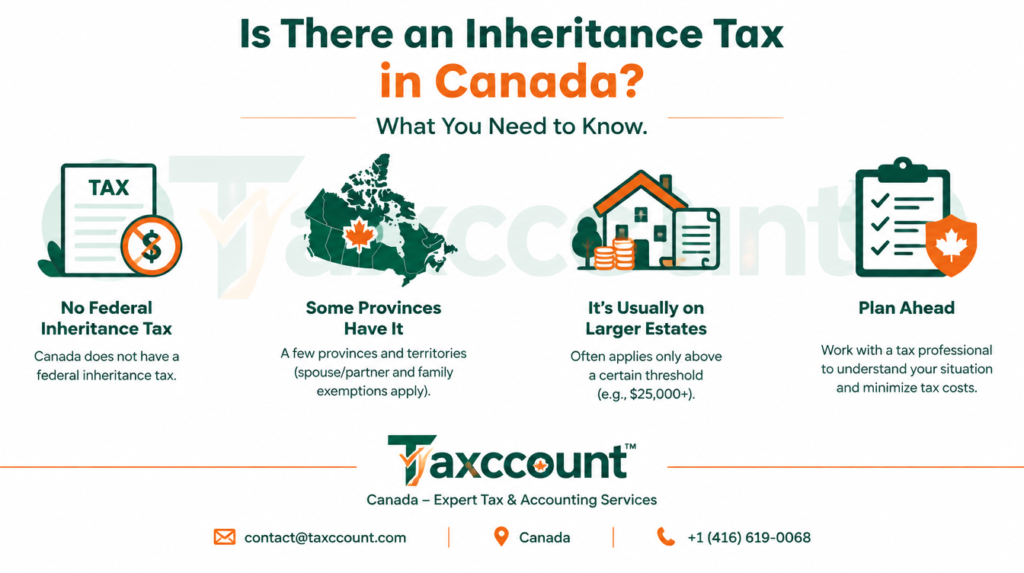
No. Canada eliminated its federal inheritance tax in 1972. There is no provincial inheritance tax in any Canadian province either. Unlike the United States or the United Kingdom, Canada does not charge a tax specifically on the act of receiving an inheritance.
Contact Taxccount for expert guidance today
☎️ Get HelpThis means:
- If you inherit $200,000 in cash, you do not pay tax on that amount
- If you inherit a car worth $50,000, you do not pay tax on receiving it
- If you inherit stocks or property, you do not pay tax just for receiving them
However, the estate of the person who died may face significant taxes before those assets reach you.
What Is a Deemed Disposition?
When someone dies in Canada, the CRA treats the deceased as if they sold all of their assets at fair market value on the day of death. This is called a deemed disposition.
The deemed disposition can trigger:
- Capital gains tax on appreciated investments
- Recapture of depreciation on rental properties or business assets
- Tax on any accrued investment income
All of these taxes are reported on the deceased person’s final tax return, which must be filed by the executor of the estate.
For example:
- The deceased owned stocks originally purchased for $50,000 that are now worth $150,000
- There is a capital gain of $100,000
- That gain is taxed on the deceased’s final return
- After the estate pays the tax, the remaining value passes to the heirs
The heirs do not pay tax on receiving the inherited stocks, but the estate already paid tax on the gain.
Exception: Spousal Rollover
If assets are left to a surviving spouse or common-law partner, the deemed disposition can be deferred. Assets roll over to the spouse at their original cost, and no tax is triggered until the surviving spouse eventually sells the assets or dies.
What Happens to RRSPs and RRIFs at Death?
RRSPs and RRIFs are a special case. If these are left to a named beneficiary who is a surviving spouse or common-law partner, they can be rolled over into the spouse’s RRSP or RRIF without triggering immediate tax.
However, if the beneficiary is anyone other than a spouse (for example, an adult child), the full value of the RRSP or RRIF is added to the deceased’s income in the year of death and taxed at their marginal rate. This can result in a very large tax bill for the estate.
For a financially dependent child or grandchild, there are some limited rollover options, but the rules are specific and should be reviewed carefully.
What About the Principal Residence?
If the deceased owned their principal residence, the principal residence exemption may apply to shelter any capital gains on that property from tax. If the home was the deceased’s principal residence for all years of ownership, no capital gains tax applies on the deemed disposition.
However, if the home was only a principal residence for part of the ownership period — perhaps because it was once a rental — part of the gain may be taxable.
Provincial Estate Administration Tax
Although there is no inheritance tax, some provinces charge estate administration tax (sometimes called probate fees) when an estate is processed through the courts.
This is not technically an income tax. It is a fee charged by the province to validate the will and give the executor legal authority to administer the estate.
In Ontario, the rate is approximately 1.5% of the estate value over $50,000. Other provinces have different rates, and some provinces have eliminated or reduced probate fees significantly.
This fee is paid by the estate before assets are distributed, not by the heirs.
What Heirs Actually Receive
After the estate pays all taxes on the final return and any applicable provincial fees, the remaining assets pass to the heirs free of tax. The heirs inherit the net after-tax value.
Once heirs have the assets:
- Cash they receive is theirs to keep tax-free
- Investments they inherit have a new adjusted cost base equal to the fair market value at the time of inheritance
- Future gains on those investments will be taxable when they eventually sell
Estate Planning Tips
There are several strategies that can reduce the tax burden at death:
1. Name a spouse as RRSP/RRIF beneficiary to defer tax.
2. Use a spousal trust to defer capital gains on investment assets.
3. Designate beneficiaries on registered accounts and life insurance to avoid probate.
4. Gift assets during your lifetime to reduce what passes through the estate.
5. Work with a financial planner to structure your estate to minimize taxes.
These strategies require careful planning and professional advice.
Table of Summary
| Inheritance Tax Topic | Key Information |
|---|---|
| Inheritance Tax in Canada | Canada has no federal or provincial inheritance tax. Beneficiaries generally do not pay tax simply for receiving an inheritance. |
| Cash Inheritance | Inherited cash, such as $200,000 from an estate, is generally received tax-free. |
| Inherited Property and Stocks | Receiving a car, stocks, or property is generally not taxable, but taxes may apply to the deceased’s estate before distribution. |
| Deemed Disposition | When someone dies, their assets are generally treated as sold at fair market value, potentially triggering capital gains tax or other taxes on the deceased’s final tax return. |
| Capital Gains Tax | Gains on investments or other assets may be taxable on the deceased’s final return before the estate distributes the remaining assets. |
| Spousal Rollover | Assets transferred to a surviving spouse or common-law partner may qualify for a tax-deferred rollover, postponing tax until a later sale or death. |
| RRSPs and RRIFs | These accounts may roll over tax-deferred to a surviving spouse. If left to other beneficiaries, their value is generally included in the deceased’s income, subject to limited exceptions. |
| Principal Residence Exemption | The exemption may eliminate capital gains tax on a home that qualifies as the deceased’s principal residence for the relevant ownership period. |
| Estate Administration Tax | Some provinces charge probate or estate administration fees when an estate is processed through the courts. These fees are paid by the estate, not directly by beneficiaries. |
| Ontario Probate Fees | The article states that Ontario’s estate administration tax is approximately 1.5% of the estate value over $50,000. |
| What Heirs Receive | Beneficiaries generally receive the remaining assets after the estate settles applicable taxes and fees. |
| Inherited Investments | Inherited investments generally have an adjusted cost base based on their fair market value at the time of death. Future gains may be taxable when sold. |
| Life Insurance Benefits | Life insurance death benefits paid to a named beneficiary are generally received tax-free. |
| Selling Inherited Assets | Capital gains tax may apply when an inherited asset is sold for more than its adjusted cost base at the time of inheritance. |
| Estate Planning Strategies | Naming a spouse as an RRSP/RRIF beneficiary, using a spousal trust, designating beneficiaries, and planning lifetime gifts may help manage estate taxes and probate costs. |
| Executor’s Responsibilities | The executor must ensure the deceased’s taxes are addressed before distributing estate assets. Assets may need to be sold if the estate lacks sufficient funds to pay its tax liabilities. |
| Professional Tax Advice | Estate planning and inheritance tax matters may require professional guidance to help reduce tax liabilities and support compliance with CRA requirements. |
Frequently Asked Questions
Do I pay tax when I receive money from a parent’s estate?
Generally no. If the estate has paid all taxes owed by the deceased, you receive your inheritance tax-free. The estate pays the taxes, not the beneficiaries.
What if the estate does not have enough money to pay the taxes?
The executor is responsible for ensuring taxes are paid before distributing assets. If the estate cannot cover the taxes, assets may need to be sold to pay the CRA.
Is life insurance payout taxable when I receive it as a beneficiary?
Generally no. Life insurance death benefits paid to a named beneficiary are received tax-free by the beneficiary. They are not included in the estate for probate purposes either.
Do I pay capital gains if I sell something I inherited?
Yes. When you eventually sell an inherited asset, you pay capital gains tax on the growth in value from the time you inherited it to the time you sold it. Your cost base is the fair market value at the date of death.
Conclusion
Canada has no inheritance tax, and heirs generally receive their share of an estate tax-free. The taxes happen at the estate level, not the beneficiary level. The deceased’s final tax return accounts for deemed dispositions, and the estate settles those bills before distributing assets.
Understanding how this works can help you plan your estate better and ensure your loved ones receive as much as possible. If you are managing a deceased person’s estate or planning your own, professional tax advice is essential.
How Taxccount Can Help
Inheritance and estate taxation can become complicated when an estate includes real estate, investments, registered retirement plans, or assets in multiple jurisdictions.
Taxccount Canada provides tax and accounting services to individuals, families, and businesses across Canada. Our team can help you understand the tax implications of inherited assets, organize relevant documentation, and identify potential reporting obligations.
If you have inherited money, property, or investments and want to understand the tax consequences, contact Taxccount Canada to discuss your situation.
Book a free consultation with Taxccount
☎️ Get HelpThis is general information only and not professional advice. Consult a professional before acting.
 Written and fact-checked by Udit Gupta
 Written and fact-checked by
 Ex Big4, Ernst & Young, Deloitte | International & Cross-Border Tax Specialist | CPA Canada In Depth Tax Training | Licensed Chartered Accountant from ICAI & MIA
Udit Gupta has over 15 years of experience helping corporations & business owners with corporate structuring, corporate tax filing, bookkeeping, payroll, GST/HST, cross-border tax and CRA representation. Big 4 trained at Ernst & Young and Deloitte, and qualified as a Chartered Accountant in India and Malaysia, he founded accounting firm in 2014 to serve entrepreneurs, startups and non-resident business owners across Canada. View Full Member Bio.
Indian Institute of Chartered Accountant Member No. (521458) | Malaysian Institute of Accountants Membership number (CA 44667) | Ex Big4,Ex Ernst & Young (EY), Ex-Deloitte | CPA Canada In-Depth Tax Training 19 Dec 2023, 12 Jul 2022, 5 Jul 2023
Editorial policy. Every article is researched against primary sources — the Income Tax Act, CRA publications and CPA Canada.