How to Split Pension Income in Canada

If you or your spouse receives pension income in retirement, pension income splitting may help reduce your combined Canadian tax bill. It allows eligible couples to allocate part of their pension income between spouses for tax purposes, potentially taking advantage of lower marginal tax rates.
Understanding what income qualifies and how to make the election correctly can help Canadian retirees improve their tax planning.
What Is Pension Income Splitting?
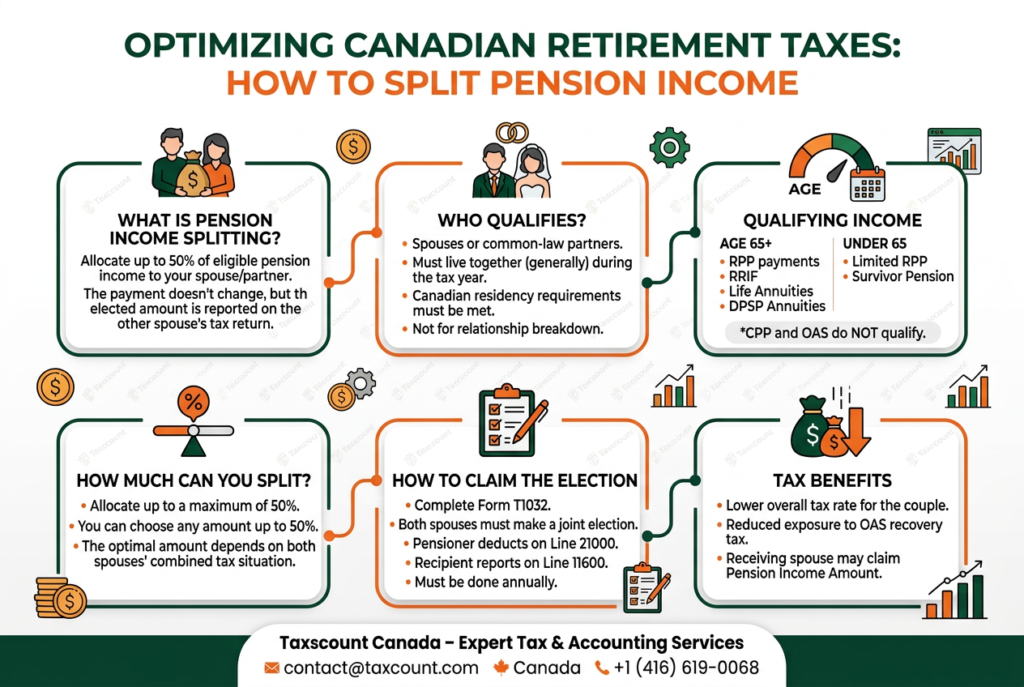
Pension income splitting allows a pensioner to allocate up to 50% of eligible pension income to their spouse or common-law partner for tax purposes.
The pension itself is not transferred. Payments continue to go to the pensioner, while the elected amount is allocated to the other spouse when preparing their income tax returns.
This strategy can be particularly useful when one spouse has significantly more taxable income than the other.
Get Pension Tax Help
☎️ Get HelpWhat Qualifies as Eligible Pension Income?
Eligible pension income depends partly on the pensioner’s age.
For individuals age 65 or older, qualifying income can include:
- Registered Pension Plan (RPP) payments
- Certain RRIF payments
- Life annuity payments from an RRSP
- Certain DPSP annuity payments
For individuals under age 65, eligible income is generally more limited and can include certain Registered Pension Plan payments and qualifying survivor pension income.
CPP and OAS do not qualify for the regular pension income splitting election.
Who Can Split Pension Income?
Generally, spouses or common-law partners must satisfy the applicable eligibility requirements.
Key conditions include:
- You must be married or in a common-law partnership.
- You must generally have lived together during the tax year.
- Applicable Canadian residency requirements must be met.
- Special rules apply when spouses are living separate and apart because of a relationship breakdown.
Eligibility should be reviewed for each tax year.
How Much Pension Income Can You Split?
You can generally allocate up to 50% of eligible pension income to your spouse or common-law partner.
You do not have to split the maximum amount.
For example, if you have $60,000 of eligible pension income, up to $30,000 may potentially be allocated to your spouse for tax purposes.
The optimal amount depends on both spouses’ taxable income, tax brackets, deductions, credits and other retirement income.
How to Claim Pension Income Splitting
Pension income splitting requires a joint election.
Generally, the process includes:
- Complete Form T1032, Joint Election to Split Pension Income.
- Both spouses make the election for the applicable tax year.
- The pensioner deducts the elected split-pension amount on line 21000 of the T1 return.
- The receiving spouse reports the elected amount on line 11600.
The election must generally be made each year. It does not automatically carry forward.
Professional tax return filing services can help ensure the election is correctly reflected on both spouses’ returns.
Tax Benefits of Pension Income Splitting
Pension income splitting can provide several potential tax advantages.
Lower Marginal Tax Rate
If one spouse has significantly higher taxable income, transferring eligible pension income to the lower-income spouse may reduce the couple’s overall tax burden.
Reduced OAS Recovery Tax
OAS itself cannot be split under these rules. However, reducing the higher-income spouse’s net income through eligible pension splitting may help reduce exposure to the OAS recovery tax.
Pension Income Amount
Depending on the circumstances, the spouse receiving the allocated pension income may also qualify for the pension income amount.
Is CPP or OAS Eligible for Pension Splitting?
CPP and OAS benefits do not qualify for the regular pension income splitting election using Form T1032.
CPP has a separate pension-sharing arrangement for eligible spouses and common-law partners. This is different from income tax pension splitting.
OAS cannot be split between spouses.
Table of Summary
| Section | Easy Information |
|---|---|
| 1. Topic | The article explains how to split pension income in Canada and how eligible couples may use pension splitting to reduce their combined tax burden. |
| 2. What Is Pension Income Splitting? | A pensioner can generally allocate up to 50% of eligible pension income to their spouse or common-law partner for income tax purposes. The actual pension payment is not transferred. |
| 3. Eligible Pension Income | For individuals 65 or older, eligible income can include RPP payments, certain RRIF payments, RRSP life annuity payments and certain DPSP annuity payments. Eligibility is more limited for those under 65. |
| 4. CPP & OAS | CPP and OAS do not qualify for the regular pension income splitting election. CPP has a separate pension-sharing arrangement, while OAS cannot be split. |
| 5. Who Can Split Pension Income? | Generally, eligible spouses or common-law partners can split pension income if they meet the applicable relationship, living-together and Canadian residency requirements. |
| 6. How Much Can Be Split? | Up to 50% of eligible pension income can generally be allocated. You do not have to split the full 50%; the amount can be selected based on the couple’s tax situation. |
| 7. How to Claim It | Couples generally complete Form T1032 – Joint Election to Split Pension Income. The pensioner deducts the elected amount on line 21000, and the receiving spouse reports it on line 11600. |
| 8. Annual Election | Pension income splitting generally requires a new election each tax year and does not automatically carry forward. |
| 9. Potential Tax Benefits | Pension splitting may help lower the couple’s overall tax burden, reduce the higher-income spouse’s marginal tax exposure and potentially reduce OAS recovery tax. |
| 10. Key Takeaway | Pension income splitting can be an effective retirement tax strategy, but the best split depends on both spouses’ income, deductions, credits, tax brackets and other retirement income. |
Frequently Asked Questions
Can I split 50% of my pension with my spouse?
You can generally allocate up to 50% of eligible pension income. You can also choose a lower percentage if it produces a better combined tax result.
Is RRIF income eligible for pension splitting?
Certain RRIF income can qualify, particularly when the pensioner is age 65 or older.
Can CPP income be split?
CPP does not qualify for the T1032 pension income splitting election. However, CPP has separate pension-sharing provisions for eligible couples.
Can OAS income be split?
No. OAS benefits are not eligible for pension income splitting.
What form is used to split pension income?
Form T1032, Joint Election to Split Pension Income, is generally used to make the election.
Can pension splitting reduce the OAS clawback?
Potentially. Allocating eligible pension income can reduce the pensioner’s net income and may therefore reduce OAS recovery tax, depending on their income level.
Do I need to elect pension splitting every year?
Yes. Pension income splitting is generally an annual election, and the optimal amount should be reviewed each year.
Need Help With Pension Income Splitting?
Taxccount Canada provides tax and accounting services and tax return filing services for Canadian retirees and families.
Our tax accountants can help determine eligible pension income, calculate an appropriate pension split, prepare the required election and accurately complete your Canadian tax filing.
Need help planning your retirement taxes? Contact Taxccount Canada for professional pension income splitting and tax assistance.
Plan Your Pension Split
☎️ Get HelpThis is general information only and not professional advice. Consult a professional before acting.
 Written and fact-checked by Udit Gupta
 Written and fact-checked by
 Ex Big4, Ernst & Young, Deloitte | International & Cross-Border Tax Specialist | CPA Canada In Depth Tax Training | Licensed Chartered Accountant from ICAI & MIA
Udit Gupta has over 15 years of experience helping corporations & business owners with corporate structuring, corporate tax filing, bookkeeping, payroll, GST/HST, cross-border tax and CRA representation. Big 4 trained at Ernst & Young and Deloitte, and qualified as a Chartered Accountant in India and Malaysia, he founded accounting firm in 2014 to serve entrepreneurs, startups and non-resident business owners across Canada. View Full Member Bio.
Indian Institute of Chartered Accountant Member No. (521458) | Malaysian Institute of Accountants Membership number (CA 44667) | Ex Big4,Ex Ernst & Young (EY), Ex-Deloitte | CPA Canada In-Depth Tax Training 19 Dec 2023, 12 Jul 2022, 5 Jul 2023
Editorial policy. Every article is researched against primary sources — the Income Tax Act, CRA publications and CPA Canada.