GST/HST Registration in Canada: Do You Need to Register?

If you run a business or are self-employed in Canada, you may be required to register for GST/HST. Many people are unsure when this obligation kicks in, what the process looks like, and what it means for how they run their business.
This article explains everything you need to know about GST/HST registration in Canada in plain language.
Taxccount Canada helps businesses looking for tax and accounting services understand GST/HST registration, filing, and CRA compliance requirements.
What Is GST/HST?
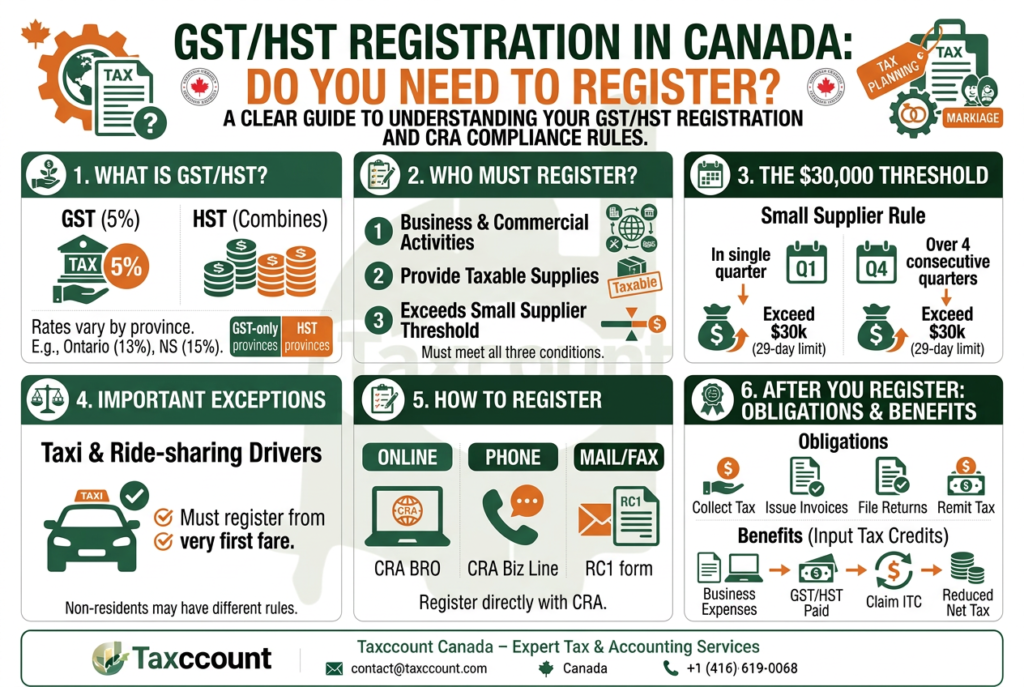
GST stands for Goods and Services Tax, a federal tax currently set at 5%. HST stands for Harmonized Sales Tax, which combines the federal GST with provincial sales tax in certain provinces.
The HST rates vary by province:
- Ontario: 13%
- Nova Scotia: 15%
- New Brunswick: 15%
- Newfoundland and Labrador: 15%
- Prince Edward Island: 15%
Provinces like British Columbia, Alberta, Saskatchewan, and Manitoba use GST (5%) plus their own provincial sales tax (PST) separately. Quebec uses the Quebec Sales Tax (QST) alongside the federal GST.
Complete GST/HST Registration
☎️ Get HelpWho Must Register for GST/HST?
You are required to register for GST/HST if you meet all three of the following conditions:
- You are in business in Canada or carry on commercial activities
- You provide taxable supplies of goods or services
- Your total taxable revenues exceed the small supplier threshold
Some exceptions apply, including: small suppliers who earn below the threshold, businesses that only provide exempt supplies (such as healthcare or residential rent), and certain non-residents.
A Small business accountant can help determine whether GST/HST registration requirements apply to your business.
The Small Supplier Threshold
If your total taxable revenues are $30,000 or less in a single calendar quarter or over four consecutive quarters, you are considered a small supplier and do not have to register for GST/HST.
However, once your revenues exceed $30,000 in any single quarter or over four consecutive quarters, you must register for GST/HST within 29 days of the sale that put you over the threshold.
Important Exceptions
- Taxi and ride-sharing drivers must register from their very first fare, regardless of revenue
- Non-residents who carry on business in Canada may have different registration requirements
Professional business tax filing services can help business owners understand their CRA obligations after exceeding the small supplier threshold.
How to Register for GST/HST
You can register for GST/HST directly with the CRA. Here are the three main ways to register:
- Online — Register through the CRA Business Registration Online (BRO) service. This is the fastest method and gives you your GST/HST number immediately.
- By phone — Call the CRA Business Enquiries line at 1-800-959-5525.
- By mail or fax — Complete Form RC1 (Request for a Business Number) and send it to your local CRA tax centre.
When you register, the CRA will assign you a Business Number (BN) with a GST/HST program account (RT suffix).
An accountant for taxes can help you understand the information required during the registration process.
When Does GST/HST Registration Take Effect?
The effective date of your GST/HST registration depends on how and when you register:
- If you exceeded the $30,000 threshold, registration takes effect on the day you made the sale that put you over the threshold
- If you are registering voluntarily, you can choose your effective date
- If you are a taxi or ride-sharing driver, registration takes effect from the date of your first fare
What Happens After You Register?
Once registered, you must:
- Collect GST/HST on all taxable sales
- Issue invoices that show the GST/HST amount charged
- File GST/HST returns with the CRA on a regular basis (monthly, quarterly, or annually)
- Remit (send) the GST/HST collected to the CRA, minus any Input Tax Credits (ITCs) you can claim
- Keep records of all GST/HST collected and paid
Tax accountants can help registered businesses maintain accurate GST/HST records and meet their filing obligations.
Input Tax Credits (ITCs)
One of the key benefits of registering for GST/HST is the ability to claim Input Tax Credits (ITCs). ITCs allow you to recover the GST/HST you paid on business expenses.
For example, if you paid $130 in HST on office supplies, you may claim that $130 as an ITC on your GST/HST return. This reduces the amount you owe to the CRA.
Common expenses eligible for ITCs include:
- Office supplies and equipment
- Professional services (accounting, legal fees)
- Advertising and marketing expenses
- Business travel and vehicle expenses
GST/HST Filing and Remittance
The CRA assigns you a filing frequency based on your annual taxable revenues:
- Annually — If taxable revenues are $1.5 million or less
- Quarterly — If taxable revenues are between $1.5 million and $6 million
- Monthly — If taxable revenues exceed $6 million
You can file your GST/HST return online through CRA My Business Account, by mail, or through an authorized tax professional.
A tax accountant near me can assist with GST/HST return preparation and remittance requirements.
Voluntary GST/HST Registration
Even if your revenues are below the $30,000 threshold, you may choose to register for GST/HST voluntarily. There are potential benefits to doing so:
- You can claim ITCs on your business expenses, reducing your overall tax burden
- It signals professionalism to clients and suppliers who are also GST/HST registered
- It simplifies your transition when you do eventually exceed the threshold
Need Help with GST/HST Registration?
Managing GST/HST registration and meeting CRA filing requirements can be challenging for self-employed individuals and small businesses. Taxccount provides guidance throughout the GST/HST process, from registration and return preparation to filing and remittance, helping you stay organized and compliant. Book a free consultation today.
Table of Summary
| Section | Easy Information |
|---|---|
| 1. Topic | The article explains GST/HST registration requirements in Canada, including who must register, the $30,000 small supplier threshold, registration methods, filing responsibilities, Input Tax Credits (ITCs), and voluntary registration options. |
| 2. What Is GST/HST? | GST (Goods and Services Tax) is a federal tax charged at 5% on taxable goods and services in Canada. HST (Harmonized Sales Tax) combines the federal GST with provincial sales tax in certain provinces. |
| 3. HST Rates by Province | HST rates vary depending on the province: • Ontario: 13% • Nova Scotia: 15% • New Brunswick: 15% • Newfoundland and Labrador: 15% • Prince Edward Island: 15% |
| 4. GST + PST Provinces | Some provinces do not use HST. They charge 5% GST plus separate provincial sales tax (PST). These include British Columbia, Alberta, Saskatchewan, and Manitoba. Quebec applies GST along with Quebec Sales Tax (QST). |
| 5. Who Must Register for GST/HST? | A business must generally register when: • It operates a business or commercial activity in Canada. • It provides taxable goods or services. • Its taxable revenues exceed the CRA small supplier threshold. |
| 6. Small Supplier Threshold | Businesses with taxable revenues of $30,000 or less in a single calendar quarter or over four consecutive calendar quarters are generally considered small suppliers and do not have to register immediately. |
| 7. When Registration Becomes Mandatory | Once taxable revenues exceed $30,000, the business must register for GST/HST within 29 days after the sale that caused it to exceed the threshold. |
| 8. Important GST/HST Exceptions | Some businesses have different rules, including: • Taxi and ride-sharing drivers must register from their first fare. • Certain non-residents may have special registration requirements. • Businesses providing only exempt supplies may not need registration. |
| 9. How to Register for GST/HST | Businesses can register through: • Online: CRA Business Registration Online (BRO) — fastest option. • Phone: CRA Business Enquiries line. • Mail/Fax: Submit Form RC1. |
| 10. GST/HST Account Number | After registration, CRA assigns a Business Number (BN) with a GST/HST program account identified by the RT suffix. This number is used for GST/HST filings and reporting. |
| 11. GST/HST Effective Date | The registration effective date depends on the situation: • If you exceed $30,000, registration starts on the date of the sale that exceeded the threshold. • Voluntary registrants can choose their effective date. • Taxi and ride-share drivers register from their first fare. |
| 12. Responsibilities After GST/HST Registration | Registered businesses must: • Collect GST/HST on taxable sales. • Show GST/HST separately on invoices. • File GST/HST returns on time. • Remit collected tax to CRA after deducting eligible ITCs. • Maintain proper GST/HST records. |
| 13. Input Tax Credits (ITCs) | ITCs allow GST/HST registrants to recover GST/HST paid on eligible business expenses. These credits reduce the amount of GST/HST payable to CRA. |
| 14. Common Expenses Eligible for ITCs | Examples of expenses that may qualify for ITCs include: • Office supplies and equipment • Accounting and legal services • Advertising and marketing costs • Business travel expenses • Vehicle expenses related to business use |
| 15. GST/HST Filing Frequency | CRA generally assigns filing frequency based on taxable revenues: • Annual filing: Revenue of $1.5 million or less • Quarterly filing: Revenue between $1.5 million and $6 million • Monthly filing: Revenue over $6 million |
| 16. How to File GST/HST Returns | GST/HST returns can be filed through: • CRA My Business Account • Mail • Authorized tax professionals using electronic filing services |
| 17. Voluntary GST/HST Registration | Businesses below the $30,000 threshold can choose to register voluntarily. Benefits include: • Claiming ITCs on business expenses. • Appearing more established to GST/HST-registered clients. • Preparing for future mandatory registration. |
| 18. Record Keeping Requirements | GST/HST-registered businesses must maintain records of GST/HST collected, GST/HST paid, invoices, receipts, and supporting documents for CRA compliance. |
| 19. Key Takeaway | GST/HST registration is required once a business exceeds CRA thresholds or falls under special rules. Proper registration, accurate filing, and claiming eligible ITCs help businesses stay compliant and reduce their tax burden. |
Frequently Asked Questions
When Do I Have to Register for GST/HST in Canada?
You generally have to register when your taxable revenues exceed the $30,000 small supplier threshold, subject to the applicable CRA rules and exceptions.
Can I Register for GST/HST If My Revenue Is Below $30,000?
Yes. You may choose voluntary GST/HST registration even if your taxable revenues remain below the small supplier threshold.
What Is a GST/HST Number?
When you register, the CRA assigns a GST/HST program account connected to your Business Number, generally identified by the RT program identifier.
Can I Claim GST/HST Paid on Business Expenses?
Registered businesses may be able to claim eligible GST/HST paid on business expenses through Input Tax Credits (ITCs).
How Often Do I Have to File a GST/HST Return?
Your GST/HST filing frequency may be annual, quarterly, or monthly depending on your taxable revenues and the reporting period assigned by the CRA.
Stay CRA GST Compliant
☎️ Get Help Written and fact-checked by Udit Gupta
 Written and fact-checked by
 Ex Big4, Ernst & Young, Deloitte | International & Cross-Border Tax Specialist | CPA Canada In Depth Tax Training | Licensed Chartered Accountant from ICAI & MIA
Udit Gupta has over 15 years of experience helping corporations & business owners with corporate structuring, corporate tax filing, bookkeeping, payroll, GST/HST, cross-border tax and CRA representation. Big 4 trained at Ernst & Young and Deloitte, and qualified as a Chartered Accountant in India and Malaysia, he founded accounting firm in 2014 to serve entrepreneurs, startups and non-resident business owners across Canada. View Full Member Bio.
Indian Institute of Chartered Accountant Member No. (521458) | Malaysian Institute of Accountants Membership number (CA 44667) | Ex Big4,Ex Ernst & Young (EY), Ex-Deloitte | CPA Canada In-Depth Tax Training 19 Dec 2023, 12 Jul 2022, 5 Jul 2023
Editorial policy. Every article is researched against primary sources — the Income Tax Act, CRA publications and CPA Canada.