Are Work Expenses Tax Deductible in Canada?
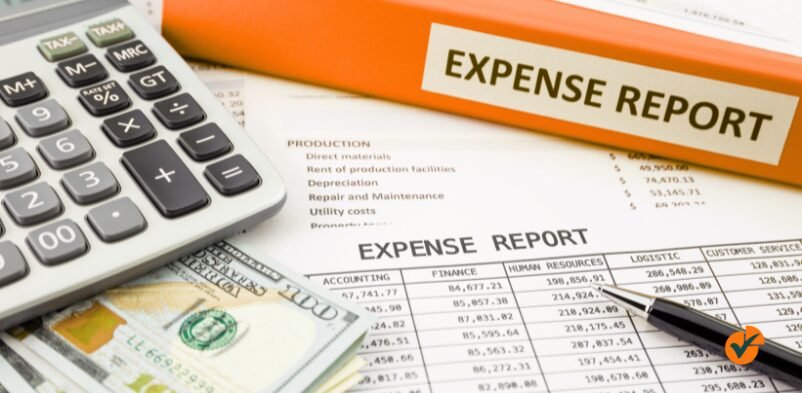
If you spend money out of pocket to do your job, you may be wondering whether those costs can be claimed on your tax return. The answer depends on your employment situation. In Canada, employees can deduct certain work-related expenses, but only if specific CRA conditions are met. This article explains what qualifies, what does not, and how to claim work expenses on your taxes.
Taxccount Canada helps individuals searching for tax filing near me understand which employment expenses may qualify as deductions under CRA rules.
Can Employees Claim Work Expenses in Canada?
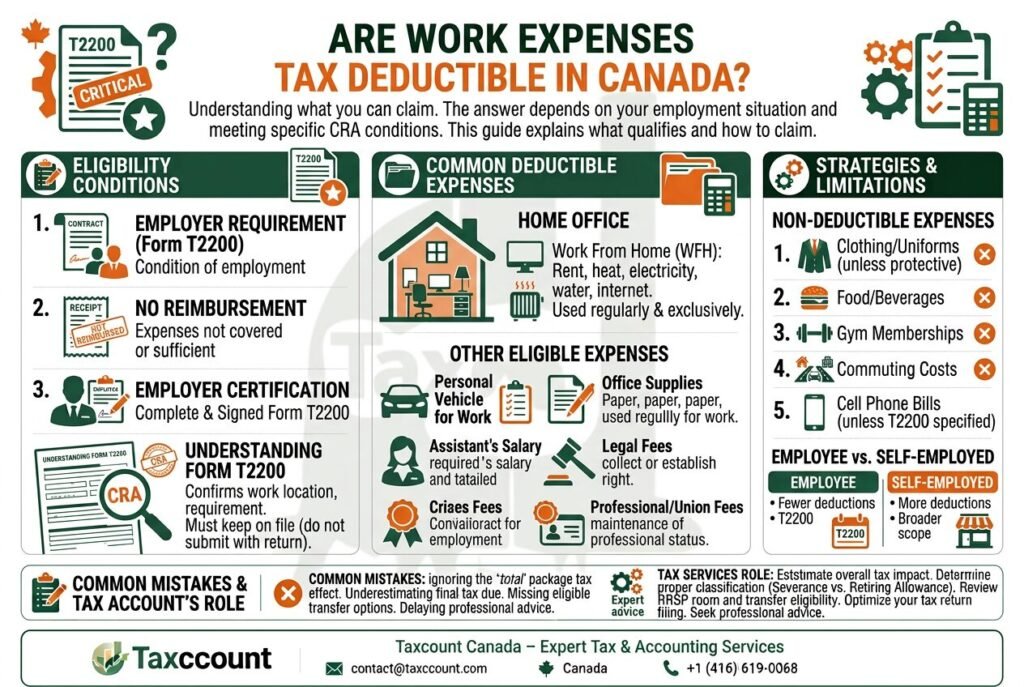
In Canada, employees can claim certain work-related expenses, but only if all of the following conditions are met:
- You were required by your employer to pay these expenses as a condition of your employment.
- You did not receive an allowance or reimbursement for the expense, or the reimbursement was not sufficient.
- Your employer has certified your eligibility by completing and signing Form T2200 (Declaration of Conditions of Employment).
Professional tax return filing services can help determine whether your work expenses qualify for a deduction.
Claim Eligible Work Expenses
☎️ Get HelpWhat Is Form T2200?
Form T2200 is a declaration signed by your employer confirming that you are required to work from a location other than the employer’s place of business, pay your own expenses, or use a portion of your home for work. You do not submit Form T2200 with your tax return, but you must keep it on file in case the CRA requests it.
An accountant for taxes can help you understand how Form T2200 applies to your employment situation.
Common Work Expenses You Can Deduct
Eligible work expenses may include:
Home Office Expenses
If you work from home and meet CRA conditions, you can deduct a proportion of rent, heat, electricity, water, and internet access fees.
Vehicle Expenses
If you use your personal vehicle for work purposes (not commuting), you can deduct fuel and oil, insurance, maintenance and repairs, and a portion of lease costs.
Office Supplies
Office supplies such as stationery and postage that you purchase for work and are not reimbursed.
Salary Paid to an Assistant
If your contract requires you to hire an assistant and your employer certifies this on Form T2200, you may deduct this cost.
Legal Fees
Fees paid to collect or establish a right to collect salary or wages from your employer.
Professional Dues and Union Fees
Annual fees required to maintain professional status or union membership.
Tax and accounting services can help ensure eligible employment expenses are claimed correctly.
Work-From-Home Expenses
Employees who work from home can deduct actual home office expenses based on the proportion of their home used for work. Eligible costs include rent, utilities, internet, and maintenance. You must use the workspace regularly and exclusively for employment purposes to qualify.
Income tax preparation near me services can help calculate the allowable home office deduction.
Expenses Employees Cannot Deduct
The following expenses are generally not deductible for employees:
- Clothing and uniforms (unless protective equipment)
- Food and beverages
- Gym memberships
- Commuting costs (travel between home and regular work location)
- Cell phone bills (unless specifically permitted under your T2200 conditions)
Tax accountants can help distinguish deductible employment expenses from personal expenses.
Self-Employed vs. Employee Work Expenses
Self-employed individuals have broader deduction rights than employees. If you operate a business, you can generally deduct any reasonable expense incurred to earn business income, without needing employer certification. Common self-employment deductions include advertising, professional fees, business insurance, and a larger range of home office and vehicle expenses.
Business tax filing requirements differ from employment expense claims, so it is important to determine which rules apply to your situation.
Table of Summary
| Section | Easy Information |
|---|---|
| 1. Topic | The article explains whether work expenses are tax deductible in Canada, including CRA requirements, eligible employment expenses, Form T2200, home office deductions, vehicle expenses, and the difference between employees and self-employed individuals. |
| 2. Can Employees Claim Work Expenses in Canada? | Yes, but only in specific situations. Employees can claim eligible work expenses if they were required to pay the expenses as part of their employment, were not reimbursed by their employer, and meet CRA requirements. |
| 3. Conditions to Claim Employment Expenses | Employees generally need to meet these conditions: • The employer required them to pay the expense as a condition of employment. • The expense was not reimbursed or the reimbursement was insufficient. • The employer completed and signed Form T2200 (Declaration of Conditions of Employment). |
| 4. What Is Form T2200? | Form T2200 is a declaration completed by the employer confirming that an employee was required to pay certain expenses or work from a location other than the employer’s workplace. It is not submitted with the tax return but must be kept in case the CRA requests it. |
| 5. Home Office Expenses | Employees who work from home may claim certain home office expenses if CRA conditions are met. Eligible expenses may include a reasonable portion of rent, electricity, heat, water, maintenance, and internet costs. The workspace must generally be used regularly and exclusively for employment purposes. |
| 6. Vehicle Expenses | Employees who use their personal vehicle for employment purposes (excluding regular commuting) may claim eligible vehicle costs, including fuel, insurance, maintenance, repairs, and certain lease expenses, if CRA conditions are satisfied. |
| 7. Office Supplies | Work-related supplies such as stationery, postage, and other office materials may be deductible if they are required for employment and not reimbursed by the employer. |
| 8. Salary Paid to an Assistant | If an employee is required by their employment agreement to hire an assistant and the employer confirms this requirement through Form T2200, the assistant’s salary may qualify as an employment expense. |
| 9. Legal Fees | Certain legal fees paid to establish or collect a right to receive salary or wages may qualify as deductible employment expenses. |
| 10. Professional Dues and Union Fees | Employees may claim eligible professional membership fees or union dues required to maintain employment status or professional standing. |
| 11. Expenses Employees Generally Cannot Claim | Common personal expenses that are generally not deductible include: • Regular clothing and uniforms (except qualifying protective equipment) • Food and beverages • Gym memberships • Normal commuting costs between home and regular workplace • Cell phone costs unless specifically allowed under employment conditions |
| 12. Work-From-Home Expense Rules | Employees working from home must meet CRA requirements before claiming home office expenses. The deduction is generally based on the portion of the home used for work and the type of employment arrangement. |
| 13. Employees vs. Self-Employed Individuals | Self-employed individuals generally have broader deduction rules than employees. They can deduct reasonable business expenses incurred to earn business income without requiring an employer-signed Form T2200. |
| 14. Common Self-Employment Deductions | Self-employed individuals may generally claim expenses such as: • Advertising costs • Professional fees • Business insurance • Business-use vehicle expenses • Home office expenses • Other reasonable business expenses |
| 15. Record Keeping Requirements | Keep receipts, invoices, mileage logs, Form T2200 (if applicable), and other supporting documents. Records should be maintained in case the CRA reviews the claim. |
| 16. Key Takeaway | Work expenses can be tax deductible in Canada, but eligibility depends on your employment status and CRA rules. Employees have stricter requirements, while self-employed individuals generally have more flexibility when claiming business expenses. |
Frequently Asked Questions
Can Employees Claim Work Expenses on Their Tax Return?
Yes. Employees may claim certain work expenses if they meet the CRA conditions and have a completed Form T2200 from their employer.
What Is Form T2200 Used For?
Form T2200 confirms that your employer required you to pay certain employment expenses. You should keep it for your records in case the CRA requests it.
Can I Claim Home Office Expenses as an Employee?
Yes. If you meet the CRA requirements and your employer has certified your eligibility, certain home office expenses may be deductible.
Are Commuting Costs Tax Deductible?
No. Travel between your home and your regular workplace is considered personal and is generally not deductible.
Can Self-Employed Individuals Claim More Expenses Than Employees?
Yes. Self-employed individuals generally have access to a broader range of deductible business expenses because they are earning business income rather than employment income.
Maximize Work Tax Deductions
☎️ Get HelpThis is general information only and not professional advice. Consult a professional before acting.
 Written and fact-checked by Udit Gupta
 Written and fact-checked by
 Ex Big4, Ernst & Young, Deloitte | International & Cross-Border Tax Specialist | CPA Canada In Depth Tax Training | Licensed Chartered Accountant from ICAI & MIA
Udit Gupta has over 15 years of experience helping corporations & business owners with corporate structuring, corporate tax filing, bookkeeping, payroll, GST/HST, cross-border tax and CRA representation. Big 4 trained at Ernst & Young and Deloitte, and qualified as a Chartered Accountant in India and Malaysia, he founded accounting firm in 2014 to serve entrepreneurs, startups and non-resident business owners across Canada. View Full Member Bio.
Indian Institute of Chartered Accountant Member No. (521458) | Malaysian Institute of Accountants Membership number (CA 44667) | Ex Big4,Ex Ernst & Young (EY), Ex-Deloitte | CPA Canada In-Depth Tax Training 19 Dec 2023, 12 Jul 2022, 5 Jul 2023
Editorial policy. Every article is researched against primary sources — the Income Tax Act, CRA publications and CPA Canada.