How Much Carbon Tax Is on Gas in Canada?

Every time you fill up at the gas station in Canada, the price includes a carbon tax component. Many Canadians want to know exactly how much the carbon tax adds to the cost of a litre of gasoline. This guide explains how the carbon tax on gas works, how much it costs, and how the rebate system offsets it.
Taxccount Canada helps individuals looking for tax filing near me understand how carbon tax affects everyday fuel costs and personal finances.
What Is Canada’s Carbon Tax?
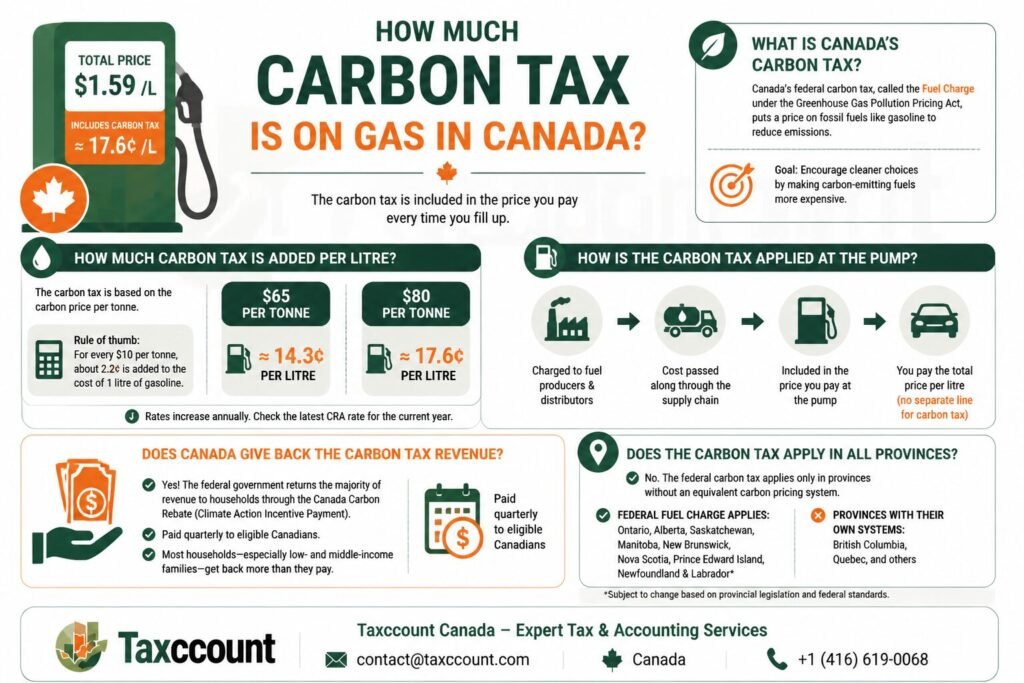
Canada’s federal carbon tax, officially called the Fuel Charge under the Greenhouse Gas Pollution Pricing Act, is a federal price placed on fossil fuels including gasoline. The purpose is to make carbon-emitting fuels more expensive, encouraging consumers and businesses to reduce their emissions and choose lower-carbon options.
The federal carbon price started in April 2019 and has been increasing gradually each year. It applies in provinces that do not have their own equivalent carbon pricing system meeting federal standards.
Professional tax and accounting services can help individuals understand how government tax policies may affect their finances.
Understand Carbon Tax
☎️ Get HelpHow Much Carbon Tax Is Added Per Litre of Gas?
The amount added per litre of gasoline is directly tied to the carbon price per tonne. As a general rule, for every $10 per tonne in the carbon price, approximately 2.2 cents is added to the cost of one litre of gasoline. This means:
- At $65 per tonne: approximately 14.3 cents per litre
- At $80 per tonne: approximately 17.6 cents per litre
The federal government has proposed further annual increases. Always check the current CRA rate schedule for the exact amount applicable in the current calendar year, as rates are subject to federal policy decisions.
A taxation accountant can help explain how changing tax rules may affect your overall financial planning.
How Is the Carbon Tax Applied at the Pump?
The carbon tax is charged to fuel producers and distributors, not directly to consumers at the point of sale. However, producers and distributors pass the cost along to consumers through higher prices at the pump. The carbon charge is embedded in the per-litre price you pay, meaning you see the total price per litre, not a separate carbon tax line.
If you have questions about tax-related costs, an accountant for taxes can provide professional guidance.
Does Canada Give Back the Carbon Tax Revenue?
Yes. The federal government returns the majority of carbon tax revenue collected from households through the Canada Carbon Rebate (formerly called the Climate Action Incentive Payment). This rebate is paid quarterly directly to eligible Canadians and varies by province and family size.
The federal government has stated that most households, particularly low- and middle-income families, receive more back in rebates than they pay in carbon charges. However, the exact amount depends on how much fuel you use.
Tax return filing services can help ensure you receive any benefits or credits you qualify for.
Does the Carbon Tax Apply in All Provinces?
No. The federal carbon pricing system applies only in provinces and territories where the federal system is in place because there is no provincial or territorial system that meets the federal requirements. Provinces such as British Columbia and Quebec operate their own carbon pricing systems. The provinces where the federal fuel charge has applied include Ontario, Alberta, Saskatchewan, Manitoba, New Brunswick, Nova Scotia, Prince Edward Island, and Newfoundland and Labrador. These arrangements can change as provincial and federal policies are updated.
A tax accountant near me can help explain how provincial tax rules apply where you live.
Table of Summary
Here is the blog information in 6 easy rows for quick understanding:
| Section | Easy Information |
|---|---|
| 1. Topic | The blog explains how much carbon tax is included in gasoline prices in Canada and how it works. |
| 2. Carbon Tax Overview | Canada’s federal carbon tax, called the Fuel Charge, applies to fossil fuels to encourage lower-carbon consumption. Introduced in April 2019, it rises gradually each year. |
| 3. Tax Per Litre | Carbon tax is passed to consumers via pump prices. Approximate additions per litre of gasoline: $65/tonne → 14.3¢, $80/tonne → 17.6¢. Rates change annually. |
| 4. How Applied | Charged to fuel producers/distributors, not directly to consumers. Cost is embedded in the per-litre price, not shown separately. |
| 5. Rebates | Most households receive the Canada Carbon Rebate quarterly, which often returns more than they paid, depending on province, family size, and fuel usage. |
| 6. Provincial Rules | Federal carbon tax applies only in provinces without a qualifying carbon pricing system. Examples: Ontario, Alberta, Saskatchewan, Manitoba, Atlantic provinces. Provinces like BC and Quebec have their own systems. |
Frequently Asked Questions
Can Tax Filing Near Me Services Explain Carbon Tax on Gas in Canada?
Yes. Tax filing near me services can help explain how fuel charges, rebates, and tax policy changes may affect your personal finances.
Do Tax and Accounting Services Help With Canada Carbon Rebate Questions?
Yes. Tax and accounting services can help review past rebate eligibility and explain how the Canada Carbon Rebate rules changed after the federal fuel charge ended.
How Much Carbon Tax Was Added to Gas in Canada Before 2025?
Before the federal fuel charge ended, the carbon price added about 17.6 cents per litre to gasoline at the $80 per tonne rate.
Can Tax Return Filing Services Help Me Claim Carbon Rebates?
Tax return filing services can help ensure your return is filed correctly for any benefit or credit eligibility, but no further federal Canada Carbon Rebate payments apply after April 2025.
Can a Taxation Accountant Explain Provincial Carbon Tax Rules?
Yes. A taxation accountant can explain whether your province has its own carbon pricing system and how it may affect fuel costs.
Should I Ask an Accountant for Taxes About Fuel Costs?
Yes. An accountant for taxes can help self-employed individuals and businesses track eligible vehicle and fuel expenses properly.
Can a Tax Accountant Near Me Help With Business Fuel Expense Claims?
Yes. A tax accountant near me can help separate personal and business vehicle use, maintain mileage records, and claim eligible fuel costs correctly.
Claim Carbon Tax Rebate
☎️ Get HelpThis is general information only and not professional advice. Consult a professional before acting.
 Written and fact-checked by Udit Gupta
 Written and fact-checked by
 Ex Big4, Ernst & Young, Deloitte | International & Cross-Border Tax Specialist | CPA Canada In Depth Tax Training | Licensed Chartered Accountant from ICAI & MIA
Udit Gupta has over 15 years of experience helping corporations & business owners with corporate structuring, corporate tax filing, bookkeeping, payroll, GST/HST, cross-border tax and CRA representation. Big 4 trained at Ernst & Young and Deloitte, and qualified as a Chartered Accountant in India and Malaysia, he founded accounting firm in 2014 to serve entrepreneurs, startups and non-resident business owners across Canada. View Full Member Bio.
Indian Institute of Chartered Accountant Member No. (521458) | Malaysian Institute of Accountants Membership number (CA 44667) | Ex Big4,Ex Ernst & Young (EY), Ex-Deloitte | CPA Canada In-Depth Tax Training 19 Dec 2023, 12 Jul 2022, 5 Jul 2023
Editorial policy. Every article is researched against primary sources — the Income Tax Act, CRA publications and CPA Canada.