Are Vehicle Expenses Tax Deductible in Canada?

If you use your car for work, you may be able to deduct a portion of the costs on your tax return. In Canada, vehicle expenses can be a significant deduction, but the rules depend on whether you are an employee or self-employed, and you must keep detailed records to support your claim.
Taxccount Canada helps individuals searching for tax filing near me understand when vehicle expenses qualify as deductions under CRA rules.
When Are Vehicle Expenses Deductible in Canada?
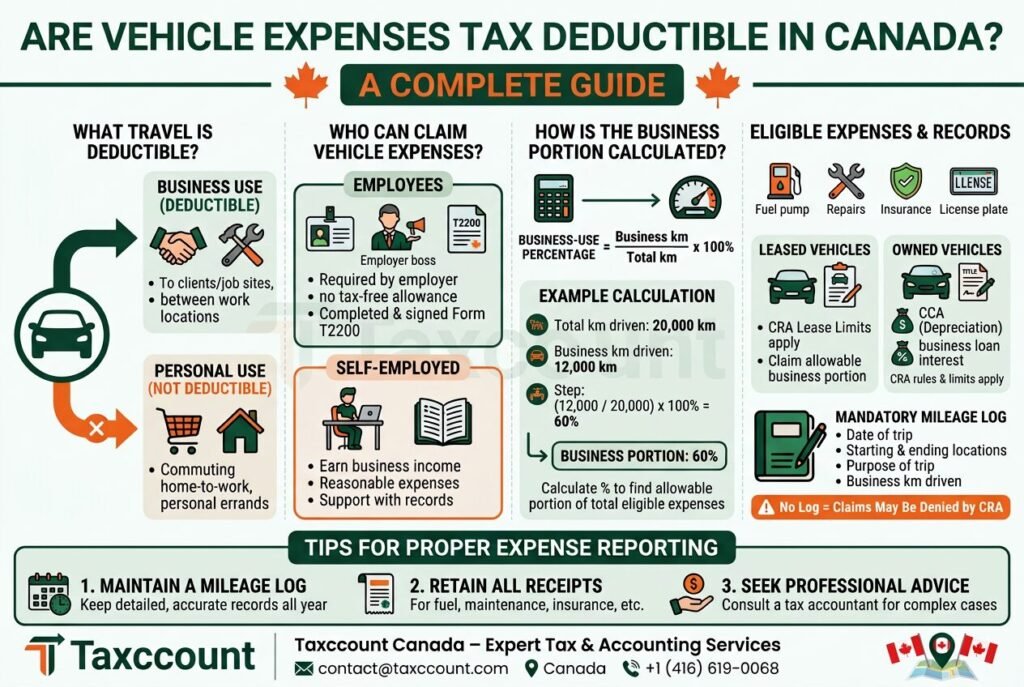
Vehicle expenses are only deductible when the vehicle is used for business or employment purposes. Personal use, including commuting from your home to your regular workplace, is never deductible. This applies to both employees and self-employed individuals.
Professional tax return filing services can help determine whether your vehicle expenses qualify for a deduction.
Claim Vehicle Deductions
☎️ Get HelpWho Can Claim Vehicle Expenses?
Employees
You can claim vehicle expenses if:
- Your employer requires you to use your own vehicle for work-related travel away from your regular workplace.
- You do not receive a non-taxable car allowance.
- Your employer provides you with a completed and signed Form T2200 (Declaration of Conditions of Employment).
An accountant for taxes can help determine whether you meet the CRA requirements for claiming employment vehicle expenses.
Self-Employed Individuals
If you are self-employed, you can deduct the business portion of your vehicle expenses without needing a Form T2200.
The expenses must:
- Be incurred to earn business income.
- Be reasonable.
- Be supported by appropriate records.
Business tax filing requires accurate calculation of the business-use portion of vehicle expenses.
What Vehicle Expenses Are Eligible?
Eligible vehicle expenses may include:
- Fuel and oil.
- Maintenance and repairs.
- Insurance premiums.
- Licence and registration fees.
- Lease payments (subject to CRA limits).
- Interest on vehicle loans (subject to CRA limits).
- Capital Cost Allowance (CCA) for owned vehicles.
- Parking fees incurred for business purposes.
- Car washes related to business use.
Tax and accounting services can help ensure only eligible expenses are claimed.
How to Calculate the Business Portion
Only the business-use portion of your vehicle expenses is deductible.
The calculation is:
Business-use percentage = Business kilometres driven ÷ Total kilometres driven × 100
For example:
- Business kilometres driven: 12,000 km
- Total kilometres driven: 20,000 km
- Business-use percentage: 60%
If your total eligible vehicle expenses were $10,000, you could generally claim 60%, or $6,000.
Income tax preparation near me services can assist in calculating your allowable deduction correctly.
The Importance of a Mileage Log
The CRA requires you to maintain a mileage log to support your vehicle expense claim.
A proper mileage log should include:
- Date of each trip.
- Starting and ending locations.
- Purpose of the trip.
- Business kilometres driven.
Without adequate records, the CRA may deny part or all of your vehicle expense claim during a review.
Tax accountants recommend maintaining your mileage log throughout the year rather than recreating it later.
Leased vs. Owned Vehicles
The tax treatment differs depending on whether your vehicle is leased or owned.
Leased Vehicles
The CRA limits the amount of lease payments that can be deducted. Only the eligible business-use portion of allowable lease costs may be claimed.
Owned Vehicles
If you own your vehicle, you may claim depreciation through Capital Cost Allowance (CCA), subject to CRA rules and prescribed limits.
Interest paid on a vehicle loan may also be deductible, subject to annual CRA limits.
A tax accountant near me can help determine the most appropriate treatment for leased or owned business vehicles.
Table of Summary
Here is the blog information in 6 easy rows for quick understanding:
| Section | Easy Information |
|---|---|
| 1. Topic | The blog explains whether vehicle expenses are tax deductible in Canada and the CRA rules for employees and self-employed individuals. |
| 2. Eligibility Rules | Vehicle expenses are deductible only for business or employment purposes. Personal use and regular commuting from home to work are not deductible. |
| 3. Employees vs. Self-Employed | Employees need employer-required vehicle use and a signed Form T2200. Self-employed individuals can claim the business-use portion without T2200 if expenses are reasonable and supported by records. |
| 4. Eligible Vehicle Expenses | Claimable costs may include fuel, maintenance, repairs, insurance, licence fees, lease payments (within limits), loan interest (within limits), CCA, parking fees, and business-related car washes. |
| 5. Business Use Calculation | Only the business portion can be claimed: Business kilometres ÷ Total kilometres × 100. Example: 12,000 business km ÷ 20,000 total km = 60% deductible use. |
| 6. Records & Vehicle Type | Maintain a detailed mileage log with dates, locations, trip purpose, and kilometres. Tax treatment differs for leased vehicles (lease limits) and owned vehicles (CCA and interest rules). |
FAQs
Can I Claim My Daily Commute to Work?
No. Travel between your home and your regular workplace is considered personal travel and is generally not deductible.
Can Employees Claim Vehicle Expenses?
Yes. Employees may qualify if they meet the CRA requirements, use their own vehicle for employment purposes, and have a signed Form T2200 from their employer.
Can Self-Employed Individuals Claim Vehicle Expenses?
Yes. Self-employed individuals may deduct the business-use portion of eligible vehicle expenses incurred to earn business income.
Do I Need a Mileage Log?
Yes. The CRA requires a mileage log or similar supporting records to substantiate the business-use portion of your vehicle expenses.
Can I Claim Fuel, Insurance, and Repairs?
Yes. Eligible vehicle expenses may include fuel, insurance, repairs, maintenance, licence fees, parking, lease costs, loan interest, and Capital Cost Allowance, provided they relate to business use and meet CRA requirements.
Maximize Vehicle Tax Savings
☎️ Get HelpThis is general information only and not professional advice. Consult a professional before acting.
 Written and fact-checked by Udit Gupta
 Written and fact-checked by
 Ex Big4, Ernst & Young, Deloitte | International & Cross-Border Tax Specialist | CPA Canada In Depth Tax Training | Licensed Chartered Accountant from ICAI & MIA
Udit Gupta has over 15 years of experience helping corporations & business owners with corporate structuring, corporate tax filing, bookkeeping, payroll, GST/HST, cross-border tax and CRA representation. Big 4 trained at Ernst & Young and Deloitte, and qualified as a Chartered Accountant in India and Malaysia, he founded accounting firm in 2014 to serve entrepreneurs, startups and non-resident business owners across Canada. View Full Member Bio.
Indian Institute of Chartered Accountant Member No. (521458) | Malaysian Institute of Accountants Membership number (CA 44667) | Ex Big4,Ex Ernst & Young (EY), Ex-Deloitte | CPA Canada In-Depth Tax Training 19 Dec 2023, 12 Jul 2022, 5 Jul 2023
Editorial policy. Every article is researched against primary sources — the Income Tax Act, CRA publications and CPA Canada.