Can You Claim Health Insurance Premiums on Your Taxes in Canada?

If you pay out of pocket for health or dental coverage, you may be able to get some of that money back at tax time. Health insurance premiums can qualify as a medical expense in Canada, allowing you to claim them on your annual income tax return.
Can You Claim Health Insurance Premiums on Your Taxes?
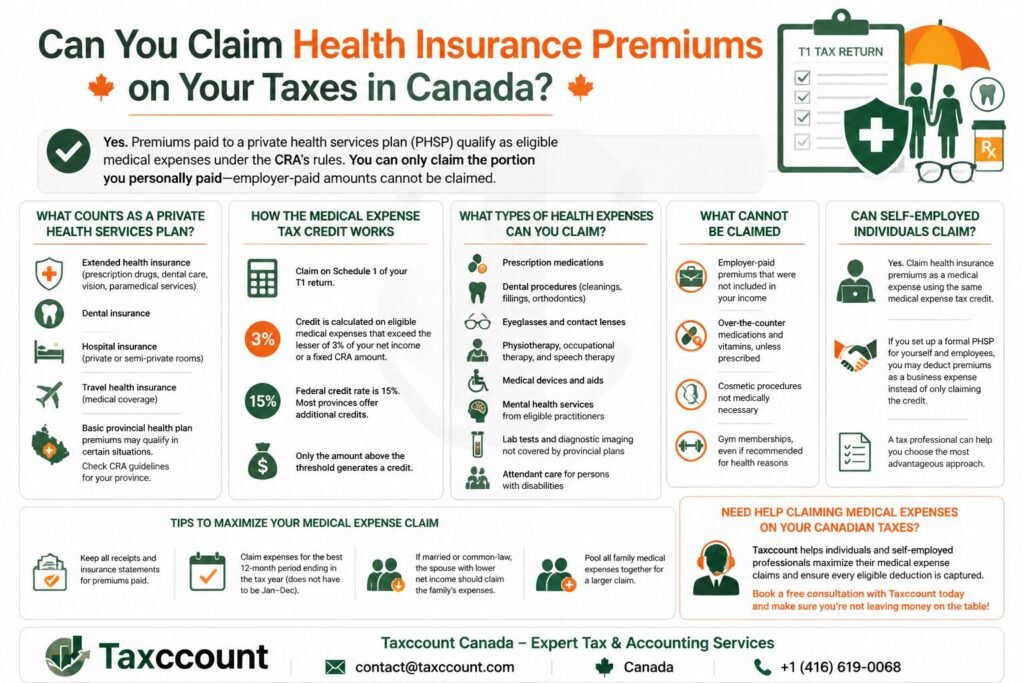
Yes. In Canada, premiums paid to a private health services plan (PHSP) qualify as eligible medical expenses under the CRA’s medical expense tax credit rules. However, you can only claim premiums that you personally paid. Any portion covered by your employer cannot be claimed.
Claim Health Premiums
☎️ Get HelpWhat Counts as a Private Health Services Plan?
A private health services plan is an insurance plan that covers medical and dental expenses not covered by a provincial health plan. Examples include:
- Extended health insurance that covers prescription drugs, dental care, vision, and paramedical services
- Dental insurance
- Hospital insurance for private or semi-private rooms
- Travel health insurance that provides medical coverage
Basic provincial health plan premiums, such as those that previously existed in British Columbia or Ontario, may also qualify in certain situations. Check the CRA guidelines for your province.
How the Medical Expense Tax Credit Works
Health insurance premiums are claimed through the federal medical expense tax credit on Schedule 1 of your T1 return. The credit is calculated on the amount of eligible medical expenses that exceeds a threshold, which is the lesser of three percent of your net income or a fixed dollar amount set by the CRA each year.
This means only the portion of your total eligible medical expenses above this threshold generates a credit. The federal credit rate is fifteen percent, and most provinces also offer their own medical expense credits on top of the federal amount.
What Types of Health Expenses Can You Claim?
In addition to health insurance premiums, eligible medical expenses include:
- Prescription medications
- Dental procedures including cleanings, fillings, and orthodontics
- Eyeglasses and contact lenses
- Physiotherapy, occupational therapy, and speech therapy
- Medical devices and aids
- Mental health services from eligible practitioners
- Lab tests and diagnostic imaging not covered by provincial plans
- Attendant care for persons with disabilities
What Cannot Be Claimed?
The following are not eligible for the medical expense tax credit:
- Employer-paid premiums that were not included in your income
- Over-the-counter medications and vitamins, unless prescribed by a doctor
- Cosmetic procedures not medically necessary
- Gym memberships, even if recommended for health reasons
Can Self-Employed Individuals Claim Health Insurance?
Yes. Self-employed individuals can claim health insurance premiums as a medical expense using the same medical expense tax credit. Additionally, if you set up a formal private health services plan for yourself and your employees as a business expense, you may be able to deduct the premiums as a business cost rather than only claiming the credit. A tax professional can help you determine the most advantageous approach for your situation.
Tips to Maximize Your Medical Expense Claim
To get the most out of your medical expense claim:
- Keep all receipts and insurance statements for premiums paid
- Claim expenses for the best twelve-month period ending in the tax year, which does not have to be January to December
- If you are married or in a common-law relationship, the spouse with lower net income should claim the family’s medical expenses, as the threshold is lower
- Pool all family medical expenses together for a larger claim
Need Help Claiming Medical Expenses on Your Canadian Taxes?
Taxccount helps individuals and self-employed professionals maximize their medical expense claims and ensure every eligible deduction is captured. Book a free consultation with Taxccount today and make sure you are not leaving money on the table at tax time.
Table of Summary
Here is the blog information in 6 easy rows for quick understanding:
| Section | Easy Information |
|---|---|
| 1. Topic | The blog explains claiming health insurance premiums on taxes in Canada and which expenses qualify. |
| 2. Eligible Claim | Premiums paid to a Private Health Services Plan (PHSP) count as medical expenses. Employer-paid portions cannot be claimed. |
| 3. What Counts as PHSP | Covers extended health, dental, hospital insurance, travel insurance, and sometimes basic provincial premiums (check CRA guidelines). |
| 4. How the Credit Works | Claimed via Schedule 1 of T1 return. Only expenses exceeding 3% of net income or the CRA’s fixed threshold qualify. Federal credit rate: 15%; provincial credits may also apply. |
| 5. Other Eligible Expenses | Prescription drugs, dental work, eyeglasses, therapies, medical devices, mental health services, lab tests, attendant care. Not eligible: OTC meds, cosmetic procedures, gym memberships, employer-paid premiums. |
| 6. Tips & Self-Employed Rules | Self-employed can claim premiums as a medical expense or, via a PHSP for employees, as a business expense. Maximize claims by keeping receipts, using a 12-month window, and having the lower-income spouse claim family expenses. |
Frequently Asked Questions
Can I claim my spouse’s health insurance premiums?
Yes. You can combine eligible medical expenses for yourself, your spouse or common-law partner, and your dependent children in a single claim. The lower-income spouse should claim the combined expenses.
Are group benefit premiums deductible if I pay part of them?
If your employer offers a group plan and you pay a portion of the premiums yourself, and that amount was not reimbursed or excluded from your income, your personal share may qualify as an eligible medical expense.
How do I claim health insurance premiums on my tax return?
Enter the total eligible medical expenses on Line 33099 of your T1 return or Schedule 1. Include all receipts and documentation. Tax software will automatically calculate the allowable credit based on your net income threshold.
Ready to Get Every Tax Credit You Deserve?
Medical expenses, including health insurance premiums, are one of the most commonly missed deductions on Canadian tax returns. Taxccount’s tax professionals ensure you claim everything you are entitled to. Book a free consultation today.
Maximize Medical Expense Credit
☎️ Get HelpThis is general information only and not professional advice. Consult a professional before acting.
 Written and fact-checked by Udit Gupta
 Written and fact-checked by
 Ex Big4, Ernst & Young, Deloitte | International & Cross-Border Tax Specialist | CPA Canada In Depth Tax Training | Licensed Chartered Accountant from ICAI & MIA
Udit Gupta has over 15 years of experience helping corporations & business owners with corporate structuring, corporate tax filing, bookkeeping, payroll, GST/HST, cross-border tax and CRA representation. Big 4 trained at Ernst & Young and Deloitte, and qualified as a Chartered Accountant in India and Malaysia, he founded accounting firm in 2014 to serve entrepreneurs, startups and non-resident business owners across Canada. View Full Member Bio.
Indian Institute of Chartered Accountant Member No. (521458) | Malaysian Institute of Accountants Membership number (CA 44667) | Ex Big4,Ex Ernst & Young (EY), Ex-Deloitte | CPA Canada In-Depth Tax Training 19 Dec 2023, 12 Jul 2022, 5 Jul 2023
Editorial policy. Every article is researched against primary sources — the Income Tax Act, CRA publications and CPA Canada.