What Can You Claim on Your Taxes in Canada? A Complete Guide

Every year, millions of Canadians file their taxes without claiming all the deductions and credits they are entitled to. This means many people pay more tax than they need to. Knowing what you can claim is one of the most important things you can do before you file.
This guide explains the most common things you can claim on your Canadian income tax return, in plain language.
Deductions vs. Credits: What Is the Difference?
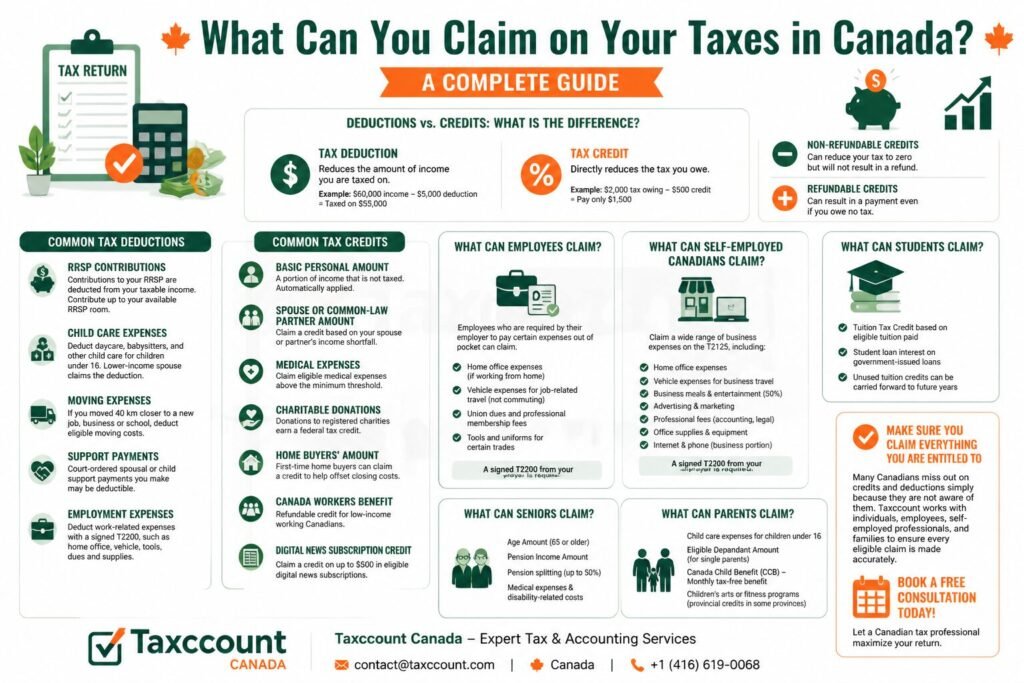
Before diving into specific claims, it helps to understand the difference between a deduction and a credit:
- Tax deduction: Reduces the amount of income you are taxed on. For example, if you earn $60,000 and have a $5,000 deduction, you are only taxed on $55,000.
- Tax credit: Directly reduces the tax you owe. If you owe $2,000 in tax and have a $500 credit, you only pay $1,500.
- Non-refundable credits can reduce your tax to zero but will not result in a refund.
- Refundable credits can result in a payment even if you owe no tax.
Maximize Your Tax Claims
☎️ Get HelpCommon Tax Deductions in Canada
RRSP Contributions
Contributions to your Registered Retirement Savings Plan (RRSP) are deducted directly from your taxable income. You can contribute up to your available RRSP room (shown on your CRA Notice of Assessment). This is one of the most powerful deductions available to Canadians.
Child Care Expenses
If you paid for daycare, babysitters, or other child care for children under 16, you may be able to deduct these costs. Generally, the lower-income spouse must claim the deduction.
Moving Expenses
If you moved at least 40 km closer to a new job, business, or school, you may deduct eligible moving costs including movers, travel, and temporary accommodation.
Support Payments
Court-ordered spousal or child support payments you make may be deductible. The recipient must also report them as income.
Employment Expenses
If your employer requires you to pay certain expenses, you may be able to deduct them with a completed T2200 (Declaration of Conditions of Employment). Eligible expenses may include:
- Home office expenses
- Union and professional dues
- Vehicle expenses for work travel
- Tools and supplies (for tradespeople)
Common Tax Credits in Canada
Basic Personal Amount
Every Canadian resident is entitled to a non-refundable Basic Personal Amount, which is a portion of income that is not taxed. This is automatically applied when you file your return.
Spouse or Common-Law Partner Amount
If your spouse or partner had little or no income, you may claim a credit based on their income shortfall compared to the Basic Personal Amount.
Medical Expenses
Eligible medical expenses above a minimum threshold may be claimed as a credit. This includes prescription drugs, dental work, eyeglasses, medical devices, and certain health services not covered by provincial insurance.
Charitable Donations
Donations to registered charities generate a federal tax credit. The first $200 of donations is credited at the lowest federal rate; amounts above $200 receive a higher credit rate.
Home Buyers’ Amount
First-time home buyers may claim the Home Buyers’ Amount, a non-refundable credit based on the purchase price, to help offset closing costs.
Canada Workers Benefit
The Canada Workers Benefit (CWB) is a refundable credit for low-income working Canadians. If your income falls within the eligible range, you may receive a payment even if you owe no tax.
Digital News Subscription Credit
You can claim a non-refundable credit on up to $500 in eligible digital news subscription costs paid to a qualified Canadian journalism organization.
What Can Employees Claim?
Employees who are required by their employer to pay certain expenses out of pocket can claim:
- Home office expenses (if working from home)
- Vehicle expenses for job-related travel (not commuting)
- Union dues and professional membership fees
- Tools and uniforms for certain trades
A signed T2200 from your employer is required to claim these deductions.
What Can Self-Employed Canadians Claim?
Self-employed individuals have access to a wide range of deductions on the T2125, including:
- Home office expenses (proportional to workspace use)
- Vehicle expenses for business travel
- Business meals and entertainment (50%)
- Advertising and marketing costs
- Professional fees (accounting, legal)
- Office supplies and equipment
- Internet and phone (business portion)
What Can Students Claim?
Students in Canada can claim:
- Tuition Tax Credit based on eligible tuition paid to qualifying institutions
- Student loan interest on government-issued student loans
- Unused tuition credits can be carried forward to future years
What Can Seniors Claim?
Seniors may be eligible for:
- Age Amount: A non-refundable credit for Canadians age 65 or older
- Pension Income Amount: A credit on eligible pension income
- Pension splitting: Transfer up to 50% of eligible pension income to a spouse
- Medical expenses and disability-related costs
What Can Parents Claim?
Parents in Canada can claim:
- Child care expenses for children under 16
- Eligible Dependant Amount (for single parents)
- Canada Child Benefit (CCB): Monthly tax-free benefit (requires filing)
- Children’s arts or fitness programs (provincial credits in some provinces)
Make Sure You Claim Everything You Are Entitled To
Many Canadians miss out on credits and deductions simply because they are not aware of them. Taxccount works with individuals, employees, self-employed professionals, and families to ensure every eligible claim is made accurately.
Book a free consultation with Taxccount today and let a Canadian tax professional maximize your return.
Table of Summary
Here is the blog information in 6 easy rows for quick understanding:
| Section | Easy Information |
|---|---|
| 1. Topic | The blog explains what Canadians can claim on their taxes, including deductions and credits. |
| 2. Key Difference | Deductions reduce taxable income (e.g., RRSP, child care, moving expenses), while credits reduce tax owed directly (e.g., basic personal amount, medical expenses, charitable donations). |
| 3. Common Deductions | RRSP contributions, child care expenses, moving expenses, support payments, employment expenses (home office, union dues, vehicle, tools). |
| 4. Common Credits | Basic personal amount, spouse/common-law amount, medical expenses, charitable donations, home buyers’ amount, Canada Workers Benefit, digital news subscriptions. |
| 5. Special Groups | Employees: T2200-required work expenses; Self-employed: T2125 deductions; Students: tuition/loan interest; Seniors: Age Amount, pension credits; Parents: child care, CCB, children’s programs. |
| 6. Simple Summary | Canadians should claim all eligible deductions and credits to reduce taxes or increase refunds. Filing accurately ensures nothing is missed. |
Frequently Asked Questions
What is the most common thing Canadians claim on their taxes?
The Basic Personal Amount is applied on every return. Beyond that, RRSP contributions and medical expenses are among the most commonly claimed deductions and credits.
Can I claim work-from-home expenses in Canada?
Yes. Employees with a T2200 from their employer and self-employed individuals may claim home office expenses proportional to their workspace use.
Are RRSP contributions tax deductible?
Yes. RRSP contributions are fully deductible up to your available contribution room, and they reduce your taxable income dollar for dollar.
What receipts do I need to claim on my taxes?
Keep receipts for medical expenses, charitable donations, child care, tuition, and any employment or business expenses. CRA may request these if your return is reviewed.
Claim Every Eligible Deduction
☎️ Get HelpThis is general information only and not professional advice. Consult a professional before acting.
 Written and fact-checked by Udit Gupta
 Written and fact-checked by
 Ex Big4, Ernst & Young, Deloitte | International & Cross-Border Tax Specialist | CPA Canada In Depth Tax Training | Licensed Chartered Accountant from ICAI & MIA
Udit Gupta has over 15 years of experience helping corporations & business owners with corporate structuring, corporate tax filing, bookkeeping, payroll, GST/HST, cross-border tax and CRA representation. Big 4 trained at Ernst & Young and Deloitte, and qualified as a Chartered Accountant in India and Malaysia, he founded accounting firm in 2014 to serve entrepreneurs, startups and non-resident business owners across Canada. View Full Member Bio.
Indian Institute of Chartered Accountant Member No. (521458) | Malaysian Institute of Accountants Membership number (CA 44667) | Ex Big4,Ex Ernst & Young (EY), Ex-Deloitte | CPA Canada In-Depth Tax Training 19 Dec 2023, 12 Jul 2022, 5 Jul 2023
Editorial policy. Every article is researched against primary sources — the Income Tax Act, CRA publications and CPA Canada.