OAS Clawback in Canada: What It Is and How to Reduce It
Old Age Security (OAS) is a monthly pension that most Canadians 65 and older receive from the federal government. It is one of the pillars of retirement income in Canada. However, if your income is above a certain threshold, the government takes back some or all of your OAS payment through what is commonly called the OAS clawback.
Understanding how the clawback works, when it applies, and how to minimize it can make a meaningful difference to your retirement income.
What Is the OAS Clawback?
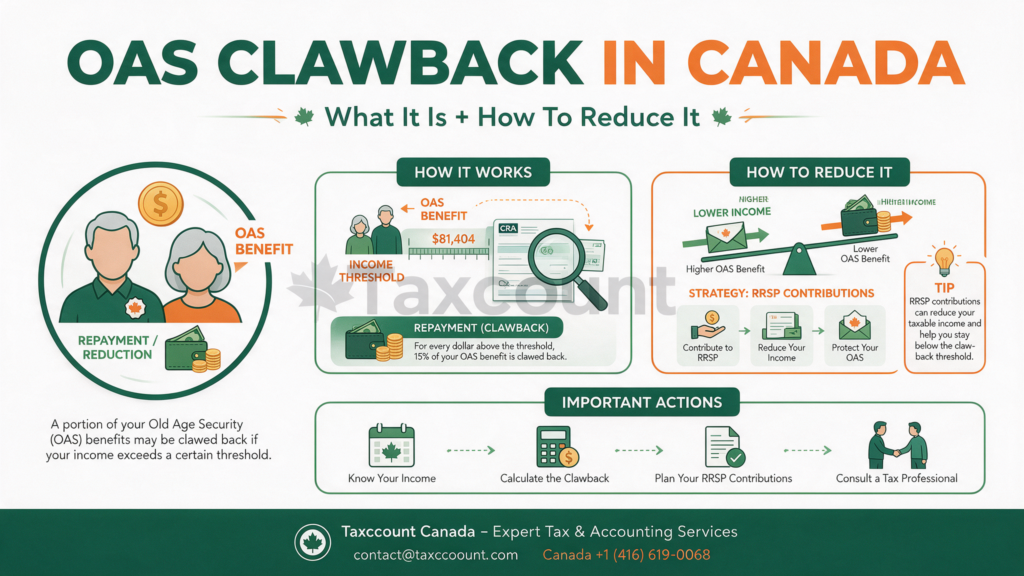
The OAS clawback is officially called the Old Age Security Recovery Tax. It is a repayment of OAS benefits that applies when your net income for the year exceeds a set threshold.
The idea behind it is that OAS is designed to support lower and middle-income retirees. Canadians with very high incomes are considered to not need the full benefit, so they are required to repay part or all of it.
Let Taxccount help you build a smart retirement income plan
☎️ Get HelpWhat Is the OAS Recovery Tax Threshold?
The income threshold at which the clawback begins changes each year. For the 2024 tax year, the threshold is approximately $90,997. This amount is indexed to inflation and increases slightly each year.
If your net income for the year is below this threshold, you keep all of your OAS.
If your net income exceeds the threshold, you must repay a portion of your OAS.
OAS is completely eliminated when your income exceeds approximately $148,451 (for 2024 figures).
Note: Always verify the current-year threshold on the CRA website or in your annual tax package, as the numbers are updated annually.
How Much Do You Repay?
The clawback rate is 15 cents for every dollar of income above the threshold.
For example:
- The threshold is $90,997
- Your net income is $110,997
- Excess income = $110,997 – $90,997 = $20,000
- Clawback = 15% x $20,000 = $3,000
- If you received $8,000 in OAS for the year, you repay $3,000 and keep $5,000
How Is the Clawback Collected?
The clawback is collected in one of two ways:
1. Tax return repayment: When you file your return, the OAS recovery tax is calculated on Schedule 2. If you owe a clawback, it is added to your total tax owing.
2. Reduced monthly OAS payments: If you had a clawback in the previous year, Service Canada will estimate your clawback for the current year and reduce your monthly OAS payments going forward. This is based on the income from your previous year’s return.
So if your income was high last year, you may already be receiving reduced OAS payments this year, and any difference is settled when you file.
What Income Counts Toward the Clawback?
The clawback is based on your net income before adjustments (line 23400 of your T1). This includes:
- Employment income
- Self-employment income
- RRSP and RRIF withdrawals
- Investment income (interest, dividends, capital gains)
- Rental income
- Pension income
- OAS and CPP payments themselves
- Foreign income
Notably, TFSA withdrawals do NOT count as income. This is an important distinction for retirement planning.
Strategies to Reduce or Avoid the OAS Clawback
1. Maximize TFSA contributions
TFSA withdrawals are tax-free and do not count toward your net income. Using your TFSA for retirement spending instead of or alongside RRIF withdrawals can help keep your income below the OAS threshold.
2. Withdraw from RRSP or RRIF early
If you have a large RRSP or RRIF, taking modest withdrawals in your early retirement years (before age 65) can reduce the size of those accounts. Smaller RRIF minimum withdrawals later mean lower income and less clawback risk.
3. Income splitting with a spouse
If your spouse is in a lower income bracket, you can allocate up to 50% of eligible pension income (including RRIF payments) to them. This lowers your net income and may reduce the clawback.
4. Defer OAS to age 70
You can choose to delay starting OAS from age 65 to age 70. Your payment increases by 0.6% for every month deferred (up to 36% more at age 70). If your income will be very high in your early sixties but lower later, deferring may reduce clawback while also increasing your lifetime benefit.
5. Use capital losses to offset gains
Capital losses from selling investments can offset capital gains, reducing your net income and potentially keeping you below the threshold.
Table of Summary
| Topic | Key Information |
|---|---|
| What Is the OAS Clawback? | The OAS clawback, officially called the Old Age Security Recovery Tax, requires higher-income recipients to repay some or all of their Old Age Security benefits when their annual net income exceeds a set threshold. |
| OAS Recovery Tax Threshold | The article gives the 2024 threshold as approximately $90,997. The threshold is indexed to inflation and changes annually. |
| When OAS Is Fully Clawed Back | The article states that OAS is fully eliminated when income exceeds approximately $148,451, using 2024 figures. |
| Clawback Rate | The recovery tax is 15% of net income above the applicable threshold, up to the amount of OAS received. |
| Clawback Example | If net income is $110,997 and the threshold is $90,997, the excess is $20,000. At 15%, the recovery tax is $3,000. If the recipient received $8,000 in OAS, they keep $5,000 after repayment. |
| How the Clawback Is Collected | The recovery tax is calculated when the income tax return is filed and added to tax owing. Service Canada may also reduce monthly OAS payments based on a prior year’s income and estimated recovery tax. |
| OAS Recovery Tax on the Tax Return | The article says the recovery tax is calculated on Schedule 2 and included in the recipient’s total tax owing. |
| Income That Counts Toward the Clawback | The calculation is based on net income before adjustments, reported on line 23400 of the T1 return. |
| Employment and Self-Employment Income | Employment income and self-employment income are included when calculating net income for the OAS recovery tax. |
| Retirement and Investment Income | RRSP and RRIF withdrawals, interest, dividends, capital gains, rental income, pension income, OAS and CPP payments, and foreign income count toward the income calculation. |
| TFSA Withdrawals | TFSA withdrawals are tax-free and do not count as income for the OAS clawback calculation. They may be useful when planning retirement withdrawals. |
| Use TFSA Savings | Using TFSA withdrawals for retirement spending instead of, or alongside, taxable RRIF withdrawals may help keep net income below the OAS threshold. |
| Withdraw from RRSP or RRIF Earlier | Taking planned withdrawals from a large RRSP or RRIF in earlier retirement years may reduce account balances and help lower mandatory RRIF withdrawals later. |
| Income Splitting with a Spouse | Eligible pension income, including qualifying RRIF payments, may be split with a spouse or common-law partner. The article notes that up to 50% may be allocated, potentially reducing net income and clawback exposure. |
| Defer OAS to Age 70 | OAS can be deferred from age 65 to age 70. The article states that payments increase by 0.6% for each month deferred, up to 36% at age 70. |
| Capital Losses | Capital losses may offset capital gains, reducing net income and potentially helping keep income below the OAS recovery threshold. |
| Filing a Tax Return | Filing an annual tax return is important for receiving OAS and calculating any recovery tax that may apply. |
| OAS Clawback vs. Regular Income Tax | The recovery tax is calculated separately from regular income tax, but it is collected through the same tax return process. |
| Non-Residents Receiving OAS | The article notes that different rules apply to non-residents. The recovery tax generally does not apply in the same way, while withholding tax may apply to OAS payments. |
| Refund When Income Is Lower Than Expected | If monthly OAS payments were reduced based on a prior year’s income but current-year income is lower, the excess recovery tax may be refunded or credited when the return is filed. |
| Key OAS Planning Considerations | Review taxable income, RRSP and RRIF withdrawal timing, TFSA withdrawals, eligible pension income splitting, and the option to defer OAS. These strategies may help reduce the recovery tax and preserve more retirement income. |
Frequently Asked Questions
Do I have to file a return to get OAS?
Yes. To receive OAS and to properly calculate any clawback, you must file a tax return each year.
Is OAS clawback the same as income tax?
The clawback is calculated separately from regular income tax, but it is collected through the same tax return process. It is a specific recovery mechanism, not a separate tax rate.
If I am a non-resident of Canada, does the clawback apply?
If you are a non-resident receiving OAS, different rules apply. The clawback is generally not applied the same way for non-residents, but withholding tax on OAS payments applies instead.
Can I get the OAS clawback refunded if my income was lower than expected?
Yes. If you received reduced OAS during the year because of last year’s clawback estimate, and your actual current-year income turns out to be lower, you will receive a refund or credit for the overpaid clawback when you file.
Conclusion
The OAS clawback applies when your net income exceeds approximately $90,997 per year and reduces or eliminates your OAS benefits at a rate of 15 cents per dollar of income above the threshold.
With the right planning — including TFSA withdrawals, income splitting, and strategic RRIF withdrawals — many retirees can reduce their net income and keep more of their OAS. If you are approaching or already in retirement with higher income levels, discussing the clawback with a tax professional can lead to real savings.
Get Help With Retirement-Income Tax Planning
The OAS clawback can be an important part of retirement planning, particularly when you receive income from several sources. A review of your RRSP and RRIF withdrawals, pension income, investments, and expected future income can help you understand the potential impact and consider suitable options.
Contact Taxccount Canada to book a free consultation and discuss your retirement-income tax planning.
Book a free consultation with Taxccount today
☎️ Get HelpThis is general information only and not professional advice. Consult a professional before acting.
 Written and fact-checked by Udit Gupta
 Written and fact-checked by
Ex Big4, Ernst & Young, Deloitte | International & Cross-Border Tax Specialist | CPA Canada In Depth Tax Training | Licensed Chartered Accountant from ICAI & MIA
Udit Gupta has over 15 years of experience helping corporations & business owners with corporate structuring, corporate tax filing, bookkeeping, payroll, GST/HST, cross-border tax and CRA representation. Big 4 trained at Ernst & Young and Deloitte, and qualified as a Chartered Accountant in India and Malaysia, he founded accounting firm in 2014 to serve entrepreneurs, startups and non-resident business owners across Canada. View Full Member Bio.
Indian Institute of Chartered Accountant Member No. (521458) | Malaysian Institute of Accountants Membership number (CA 44667) | Ex Big4,Ex Ernst & Young (EY), Ex-Deloitte | CPA Canada In-Depth Tax Training 19 Dec 2023, 12 Jul 2022, 5 Jul 2023
Editorial policy. Every article is researched against primary sources — the Income Tax Act, CRA publications and CPA Canada.