Tax on Gig Economy Income in Canada: What You Need to Report

Millions of Canadians now earn money through platforms like Uber, DoorDash, Airbnb, Fiverr, TaskRabbit, and Etsy. This type of work — often called the gig economy — gives people flexibility and extra income. But it also comes with tax responsibilities that many gig workers are not fully aware of.
This guide explains what the Canada Revenue Agency (CRA) expects from gig workers and how to stay on the right side of the tax rules.
1. What Is the Gig Economy?
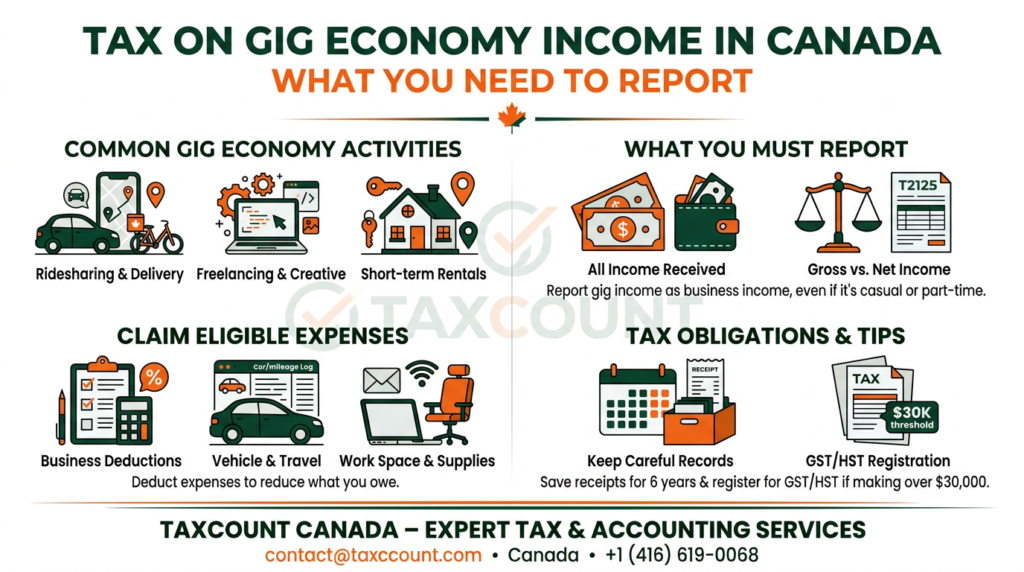
The gig economy refers to short-term, contract, or platform-based work where you earn income on a task-by-task or project-by-project basis rather than through a traditional employer-employee relationship.
Let Taxccount help you handle the tax side correctly
☎️ Get HelpExamples include:
- Driving for Uber, Lyft, or Uber Eats
- Delivering food through DoorDash, Skip the Dishes, or Instacart
- Renting your home through Airbnb or VRBO
- Freelancing on Fiverr, Upwork, or Freelancer
- Selling crafts or goods on Etsy or Shopify
- Completing tasks through TaskRabbit
- Creating content on YouTube, TikTok, or similar platforms
2. Is Gig Income Taxable in Canada?
Yes. All gig income is taxable in Canada, regardless of how small the amount is. The CRA requires you to report all income earned from gig platforms on your tax return.
Many people assume that because they receive cash payments or work through an app, the CRA does not know about it. That is a risky assumption. Many platforms issue T4A slips to gig workers, and the CRA has been increasing enforcement in this area.
3. Are You an Employee or Self-Employed?
Most gig workers are considered self-employed by the CRA, not employees. This distinction matters a lot:
As a self-employed person:
- You do not have tax withheld from your earnings
- You are responsible for paying both the employee and employer portions of Canada Pension Plan (CPP) contributions
- You can deduct business expenses from your income
- You may need to register for and remit GST/HST
Some platforms issue T4 slips (indicating employment), but most issue T4A slips (indicating self-employment income or other income). Check your slips each year.
4. How to Report Gig Income on Your Taxes
Gig income is reported as business income on your personal tax return using Form T2125 (Statement of Business or Professional Activities).
On this form, you report:
- Your gross income from all gig sources
- Your allowable business expenses
- Your net income (gross minus expenses)
The net income is then added to your other income for the year and taxed at your marginal rate.
If you receive a T4A from a platform, the amount shown in box 20 (self-employment commissions) or box 48 (fees for services) goes onto your T2125.
5. Deductions You Can Claim as a Gig Worker
The advantage of being self-employed is that you can deduct legitimate business expenses. Common deductions for gig workers include:
For drivers (Uber, DoorDash, etc.):
- Gas and fuel (business portion)
- Vehicle insurance (business portion)
- Vehicle maintenance and repairs (business portion)
- Lease or loan interest (business portion)
- Car washing (business use)
- Phone and data costs (business portion)
For freelancers:
- Home office expenses (if applicable)
- Computer and equipment costs
- Software subscriptions
- Internet costs (business portion)
- Advertising and marketing
- Professional development
For Airbnb hosts:
- Cleaning and maintenance
- Supplies provided to guests
- Utilities (proportional to rental use)
- Platform fees charged by Airbnb
You can only deduct the business-use portion of any expense. Keep records to support every deduction.
6. GST/HST and Gig Workers
If your total income from your business or self-employment exceeds $30,000 in a rolling 12-month period, you must register for GST/HST with the CRA.
Once registered, you must:
- Collect GST/HST from clients
- File GST/HST returns (quarterly or annually)
- Remit the tax you collected to the CRA
However, you also get the benefit of claiming Input Tax Credits (ITCs) — refunds of the GST/HST you paid on business expenses.
Note: Some gig platforms collect and remit GST/HST on your behalf. Always check the platform’s policies.
7. Ride-Sharing Drivers and HST
Uber and Lyft drivers in Canada are subject to special GST/HST rules. If you provide ride-sharing services, you are deemed to be in the business of transporting passengers, and you must register for and collect HST regardless of your annual income — even if you earn less than $30,000.
This is one of the most common misunderstandings among new Uber drivers. The $30,000 small supplier threshold does not apply to ride-sharing. You must register from day one.
Uber does collect HST on fares in most provinces and remits it on behalf of drivers, but you are still required to be registered.
8. Keeping Records as a Gig Worker
Good records are essential. The CRA can audit you for up to six years back, so you need to keep:
- Proof of all income (bank statements, platform earnings reports)
- Receipts for all expenses claimed
- Mileage logs for vehicle use
- Records of home office use (if applicable)
- GST/HST records (if registered)
Many gig workers use accounting apps like Wave, QuickBooks, or FreshBooks to keep their finances organized through the year.
9. Common Gig Platforms and Tax Considerations
Uber/Lyft/Uber Eats: Report income on T2125. Mandatory HST registration for ride-sharing from day one.
Airbnb: Report as rental income (T776) if you rent a property you own, or as business income (T2125) if you provide significant services. GST/HST applies if over $30,000.
Fiverr/Upwork: Report as freelance business income on T2125. You may receive a T4A. GST/HST applies over $30,000.
Etsy/Shopify: Report as business income. GST/HST applies. Keep inventory records.
YouTube/TikTok: Ad revenue, sponsorships, and brand deals are all taxable business income.
Table of Summary
| Topic | Key Information |
|---|---|
| What Is the Gig Economy? | The gig economy involves short-term, contract-based, or platform-based work where people earn income per task or project instead of working in a traditional employer-employee relationship. |
| Examples of Gig Economy Work | Common examples include driving for Uber or Lyft, delivering through DoorDash or Instacart, renting properties through Airbnb or VRBO, freelancing on Fiverr or Upwork, selling products on Etsy or Shopify, completing TaskRabbit jobs, and creating online content. |
| Is Gig Income Taxable in Canada? | Yes. All gig income is taxable in Canada, regardless of how small the amount is. Workers must report income earned through apps, platforms, cash payments, and other gig activities. |
| CRA Monitoring of Gig Income | Many platforms issue T4A slips to gig workers, and the CRA has increased enforcement and monitoring of gig income. |
| Employee vs. Self-Employed Status | Most gig workers are considered self-employed rather than employees. Some platforms issue T4 slips for employment income, while many issue T4A slips for self-employment or other income. |
| Tax Responsibilities of Self-Employed Gig Workers | Self-employed workers generally do not have tax withheld from earnings, must pay both employee and employer portions of CPP contributions, can deduct eligible business expenses, and may need to register for GST/HST. |
| How to Report Gig Income | Gig income is generally reported as business income on the personal tax return using Form T2125 – Statement of Business or Professional Activities. |
| Information Required on T2125 | Workers report gross income from all gig sources, allowable business expenses, and net income calculated by subtracting expenses from gross income. |
| How Gig Income Is Taxed | Net business income is added to other income for the year and taxed at the individual’s marginal tax rate. |
| T4A Reporting | Amounts in box 20 (self-employment commissions) or box 48 (fees for services) of a T4A are reported through Form T2125. |
| Vehicle Expenses for Drivers | Drivers may deduct the business-use portion of fuel, insurance, maintenance, repairs, lease costs or loan interest, car washing, and phone and data expenses. |
| Freelancer Business Expenses | Freelancers may claim eligible home office expenses, computer and equipment costs, software subscriptions, the business portion of internet costs, advertising, marketing, and professional development. |
| Airbnb Host Expenses | Eligible expenses may include cleaning, maintenance, guest supplies, utilities based on rental use, and Airbnb platform fees. |
| Business-Use Portion of Expenses | Only the portion of an expense related to business use can be deducted. Records must support the amounts claimed. |
| GST/HST Registration Threshold | Most gig workers must register for GST/HST when total business or self-employment income exceeds $30,000 in a rolling 12-month period. |
| GST/HST Responsibilities | Registered workers must collect GST/HST from clients, file returns quarterly or annually, and remit collected tax to the CRA. |
| Input Tax Credits (ITCs) | GST/HST registrants may claim Input Tax Credits for GST/HST paid on eligible business expenses. |
| Platform GST/HST Collection | Some platforms collect and remit GST/HST on behalf of gig workers. Workers should check the relevant platform’s policies. |
| Special Rules for Ride-Sharing Drivers | Uber and Lyft drivers providing ride-sharing services must register for and collect GST/HST regardless of annual income, including when earnings are below $30,000. |
| Ride-Sharing Registration from Day One | The $30,000 small supplier threshold does not apply to ride-sharing services. Drivers must register from the beginning of their ride-sharing activity. |
| Uber and HST Remittance | Uber collects HST on fares in most provinces and remits it on behalf of drivers, but drivers are still required to be registered. |
| Records Required by the CRA | Gig workers should retain income records, bank statements, platform earnings reports, expense receipts, vehicle mileage logs, home office records where applicable, and GST/HST records if registered. |
| CRA Audit Period | The CRA can audit records for up to six years back, making organized recordkeeping important. |
| Accounting Software | Tools such as Wave, QuickBooks, and FreshBooks can help gig workers organize income and expenses throughout the year. |
| Uber, Lyft and Uber Eats | Report income using T2125. Ride-sharing drivers must register for HST from day one, while other delivery activities follow the applicable GST/HST rules. |
| Airbnb and VRBO | Rental income from a property owned by the taxpayer is generally reported using T776. If significant services are provided, income may be treated as business income and reported using T2125. GST/HST generally applies when income exceeds $30,000. |
| Fiverr and Upwork | Freelance income is reported as business income on T2125. Workers may receive a T4A, and GST/HST registration generally applies when income exceeds $30,000. |
| Etsy and Shopify | Sales are generally reported as business income. GST/HST may apply, and sellers should maintain inventory records. |
| YouTube and TikTok | Advertising revenue, sponsorships, and brand deals are taxable business income. |
| Small Amounts of Gig Income | Even a few hundred dollars of gig income must be reported because all gig income is taxable, regardless of the amount. |
| CPP Contributions on Gig Income | Self-employed individuals pay both the employee and employer portions of CPP contributions. The article estimates this can be around 11.9% of net self-employment income, subject to annual maximum thresholds. |
| Car Payments for Delivery Drivers | Drivers can generally deduct the business-use portion of vehicle lease payments or car loan interest, rather than the full payment. They may also claim CCA (depreciation) on a purchased vehicle. |
| Key Takeaway | Gig workers must report all earnings, pay applicable income tax and CPP contributions, and register for GST/HST when required. Eligible business deductions and organized records can help reduce taxable income and support CRA compliance. |
Frequently Asked Questions
What if I only made a small amount of gig income?
All income is taxable in Canada, regardless of the amount. Even if you only made a few hundred dollars, you must report it.
Will the CRA find out about my gig income?
Many platforms report payments to the CRA directly through T4A slips. The CRA is actively monitoring gig income, so it is not worth the risk to hide it.
Do I have to pay CPP on gig income?
Yes. Self-employed individuals pay both the employee and employer portions of CPP contributions. This can add up to around 11.9% of net self-employment income (subject to yearly maximum thresholds).
Can I deduct my car payments as a delivery driver?
You can deduct the business-use portion of your lease payments or interest on a car loan, not the full payment. You also claim CCA (depreciation) on a purchased vehicle.
Conclusion
The gig economy offers real income opportunities for Canadians, but with that income comes real tax responsibility. Whether you drive for Uber, freelance on Fiverr, or rent your home on Airbnb, the CRA expects you to report your earnings, pay tax on them, and in many cases, register for GST/HST.
The good news is that you can also claim many business deductions to reduce your taxable income. Keeping organized records throughout the year makes filing much easier.
If your gig income is growing or you are unsure how to handle the tax side, a tax professional can help you stay compliant while taking every deduction available.
Get Help With Gig Economy Tax Filing in Canada
Whether you earn money from food delivery, ridesharing, freelance projects, or online services, understanding your tax obligations is essential. Reporting income correctly, claiming eligible business expenses, and meeting GST/HST requirements can help you avoid unnecessary tax complications.
Taxccount Canada provides personal tax filing, self-employment tax services, bookkeeping, and GST/HST support for individuals and small businesses across Canada.
Contact Taxccount Canada to book a free consultation and get help with your gig economy tax reporting.
File confidently with Taxccount
☎️ Get HelpThis is general information only and not professional advice. Consult a professional before acting.
 Written and fact-checked by Udit Gupta
 Written and fact-checked by
Ex Big4, Ernst & Young, Deloitte | International & Cross-Border Tax Specialist | CPA Canada In Depth Tax Training | Licensed Chartered Accountant from ICAI & MIA
Udit Gupta has over 15 years of experience helping corporations & business owners with corporate structuring, corporate tax filing, bookkeeping, payroll, GST/HST, cross-border tax and CRA representation. Big 4 trained at Ernst & Young and Deloitte, and qualified as a Chartered Accountant in India and Malaysia, he founded accounting firm in 2014 to serve entrepreneurs, startups and non-resident business owners across Canada. View Full Member Bio.
Indian Institute of Chartered Accountant Member No. (521458) | Malaysian Institute of Accountants Membership number (CA 44667) | Ex Big4,Ex Ernst & Young (EY), Ex-Deloitte | CPA Canada In-Depth Tax Training 19 Dec 2023, 12 Jul 2022, 5 Jul 2023
Editorial policy. Every article is researched against primary sources — the Income Tax Act, CRA publications and CPA Canada.