Tax Deductions for Small Businesses in Canada: What You Can Claim

Running a small business comes with a lot of costs. The good news is that many of those costs are tax-deductible. Claiming eligible business expenses reduces your net income, which lowers the amount of tax you owe. Over a full year, these deductions can add up to significant savings.
This guide covers the most common small business tax deductions in Canada and helps you understand what you can and cannot claim.
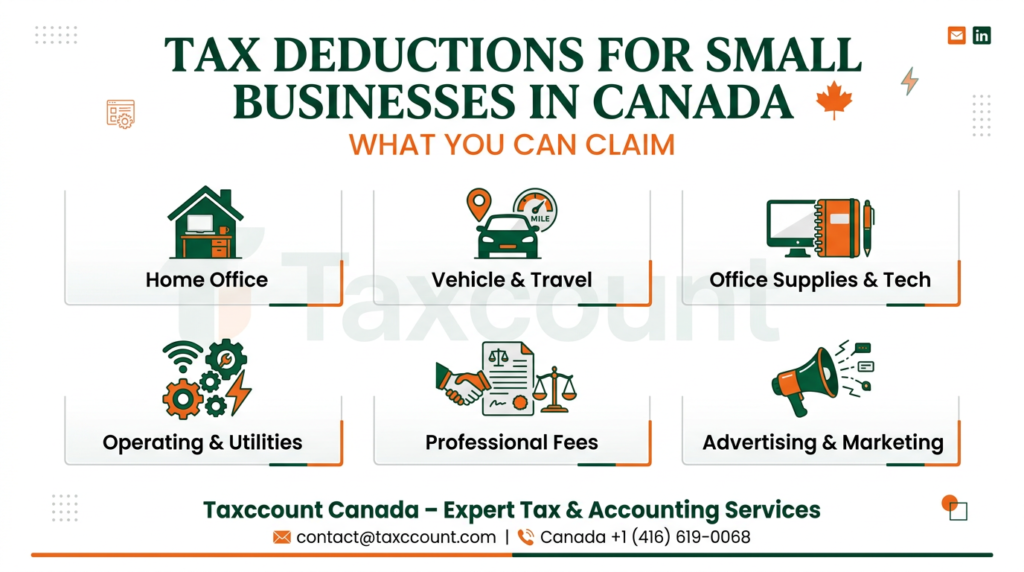
1. Why Tax Deductions Matter for Small Businesses
As a small business owner, you pay tax on your net business income — that is, your revenue minus your allowable business expenses. Every dollar you deduct reduces your taxable income by one dollar. If you are in a 40% marginal tax bracket, a $1,000 deduction saves you $400 in tax.
For this reason, keeping track of all your business expenses throughout the year is one of the smartest things you can do.
Book a free consultation with Taxccount
☎️ Get Help2. Who Can Claim Small Business Deductions?
You can claim business deductions if you:
- Are self-employed or a sole proprietor
- Operate a partnership
- Own an incorporated company (corporation)
- Carry on a profession, trade, or business in Canada
Sole proprietors and partners report business income and expenses on the T2125 form (Statement of Business or Professional Activities) as part of their personal T1 return. Corporations file a T2 corporate tax return.
3. Common Business Expenses You Can Deduct
The CRA allows you to deduct any expense that was incurred to earn business income, as long as it is reasonable. Here are the most common deductions.
4. Home Office Expenses
If you work from home, you may be able to deduct a portion of your home expenses as a business cost. You can use one of two methods:
Detailed Method: Deduct the actual costs of running the home office (utilities, internet, mortgage interest or rent, repairs, etc.) based on the percentage of your home used for business. For example, if your office takes up 10% of your home, you can deduct 10% of eligible costs.
Simplified Method (Flat Rate): You can claim a flat amount per day worked from home. The CRA has allowed this approach for eligible workers in certain periods, but always check current CRA guidelines for whether this applies to your situation.
Your home office must be either your main place of business, or used exclusively and regularly for meeting clients.
5. Vehicle Expenses
If you use a vehicle for business purposes — driving to client meetings, job sites, or suppliers — you can deduct a portion of vehicle costs based on the percentage of kilometres driven for business.
Deductible vehicle expenses include:
- Gas and fuel
- Insurance
- Maintenance and repairs
- Lease payments (subject to a ceiling)
- Depreciation through Capital Cost Allowance (CCA)
- Licensing and registration fees
- Parking (for business purposes)
You must keep a mileage log that records:
- The date of each trip
- The destination
- The business purpose
- The kilometres driven
Personal driving is not deductible. If you drive 20,000 km in a year and 12,000 km is for business, you can deduct 60% of your vehicle costs.
6. Salaries and Wages
If you have employees, their salaries and wages are fully deductible as a business expense. This includes:
- Gross wages paid to employees
- Bonuses and commissions
- Your portion of Canada Pension Plan (CPP) contributions
- Your portion of Employment Insurance (EI) premiums
- Employer Health Tax (where applicable)
If you pay a salary to a family member, the CRA expects the amount to be reasonable for the work performed. Paying a spouse or child an unreasonably high salary to reduce your taxes is not allowed.
7. Advertising and Marketing
Expenses related to promoting your business are generally deductible. This includes:
- Website design and hosting
- Social media advertising
- Google or Facebook ads
- Business cards and brochures
- Sponsorships with Canadian media
- Trade show fees
Note: Advertising costs directed at foreign markets or through foreign websites may have different treatment. The CRA has specific rules about advertising on foreign platforms.
8. Meals and Entertainment
The CRA allows you to deduct 50% of eligible meal and entertainment expenses if they are directly related to earning business income. For example, taking a client out to dinner counts.
You cannot deduct:
- Personal meals
- Lavish or unreasonable expenses
- Meals that are purely personal in nature
Always keep receipts and note the business purpose and who attended.
9. Professional Fees
Fees paid to accountants, lawyers, bookkeepers, and consultants for business-related services are fully deductible. This includes:
- Tax preparation fees
- Legal fees related to business contracts
- Business consulting fees
- Software subscriptions used for business (like accounting software)
10. Capital Cost Allowance (CCA)
When you buy major assets for your business — like computers, machinery, or vehicles — you cannot deduct the full cost in one year. Instead, you claim Capital Cost Allowance (CCA), which is the CRA’s version of depreciation.
The CRA assigns each type of asset a class with a specific depreciation rate. For example:
- Class 10: Most vehicles — 30% per year
- Class 8: Equipment and tools — 20% per year
- Class 50: Computer equipment — 55% per year
- Class 14.1: Goodwill and eligible capital property — 5% per year
You claim CCA on Schedule 8 of your tax return. You are not required to claim the maximum CCA in any year, which gives you flexibility to manage your taxable income.
11. What You Cannot Deduct
Some expenses are not deductible, even if they seem business-related:
- Personal expenses (groceries, personal clothing, personal travel)
- Club memberships (golf clubs, social clubs)
- Fines and penalties
- Life insurance premiums (in most cases)
- Principal portion of mortgage payments
- Capital purchases (instead, claim CCA over time)
- Expenses that are unreasonable in amount
The CRA may audit businesses that claim unusual or very high deductions relative to their income, so always keep documentation for every claim.
Table of Summary
| Topic | Key Information |
|---|---|
| Why Business Deductions Matter | Eligible expenses reduce net business income and taxable income. For example, a $1,000 deduction saves $400 in tax at a 40% marginal tax rate. |
| Who Can Claim Deductions | Self-employed individuals, sole proprietors, partners, incorporated companies, and people carrying on a profession, trade, or business in Canada may claim eligible business expenses. |
| Reporting Business Expenses | Sole proprietors and partners generally report income and expenses on Form T2125 with their personal T1 return. Corporations file a T2 corporate return. |
| General Deduction Rule | The CRA allows reasonable expenses incurred to earn business income to be deducted. |
| Home Office Expenses | A business-use portion of eligible home costs may be deductible, including utilities, internet, rent or mortgage interest, and repairs. |
| Home Office Calculation | Under the detailed method, the deduction is based on the percentage of the home used for business. The article gives 10% as an example for an office occupying 10% of the home. |
| Home Office Eligibility | The home office must generally be the main place of business or be used exclusively and regularly to meet clients. |
| Simplified Home Office Method | A flat-rate method may be available to eligible workers in certain periods. Current CRA guidance should be checked to confirm eligibility. |
| Vehicle Expenses | Business-use portions of fuel, insurance, maintenance, repairs, lease payments, CCA, licensing, registration, and business parking may be deductible. |
| Vehicle Mileage Log | Records should include each trip’s date, destination, business purpose, and kilometres driven. |
| Business vs. Personal Driving | Only business driving is deductible. The article’s example allows 60% of vehicle costs when 12,000 of 20,000 annual kilometres are business-related. |
| Salaries and Wages | Employee wages, bonuses, commissions, employer CPP and EI contributions, and applicable Employer Health Tax may be deductible. |
| Family Member Salaries | Salary paid to a spouse or child must be reasonable for the work performed. Unreasonably high payments to reduce tax are not allowed. |
| Advertising and Marketing | Website design and hosting, social media and online ads, business cards, brochures, eligible sponsorships, and trade show fees may be deductible. |
| Foreign Advertising | Advertising through foreign websites or directed at foreign markets may be subject to different CRA rules. |
| Meals and Entertainment | Generally, 50% of eligible meals and entertainment directly related to earning business income may be deducted. |
| Non-Deductible Meals | Personal, purely personal, lavish, or unreasonable meal expenses are not deductible. Keep receipts and record the business purpose and attendees. |
| Professional Fees | Business-related accounting, legal, bookkeeping, consulting, tax preparation, and accounting software costs may be deductible. |
| Capital Cost Allowance (CCA) | Major assets such as computers, machinery, and vehicles are generally deducted over time through CCA rather than fully in the year of purchase. |
| CCA Classes and Rates | The article lists Class 10 vehicles at 30%, Class 8 equipment and tools at 20%, Class 50 computer equipment at 55%, and Class 14.1 goodwill and eligible capital property at 5%. |
| Claiming CCA | CCA is claimed on Schedule 8. Businesses do not have to claim the maximum amount each year, allowing flexibility in managing taxable income. |
| Non-Deductible Personal Costs | Groceries, personal clothing, and personal travel are not deductible. |
| Other Non-Deductible Expenses | The article lists club memberships, fines and penalties, most life insurance premiums, mortgage principal, capital purchases claimed immediately, and unreasonable expenses as non-deductible. |
| Documentation and Audit Risk | Keep documentation for every claim. Unusual or unusually high deductions compared with business income may attract CRA scrutiny. |
| Cell Phone Expenses | Only the business-use portion is deductible. For example, 70% business use allows a 70% deduction. |
| Receipts and Records | The article states that records and receipts should be kept for at least six years in case of a CRA audit. |
| Startup Costs | Some pre-opening costs, such as legal fees, registration, and market research, may be deductible in the year the business starts. |
| Business Losses | Business losses can generally be carried back three years or forward 20 years to offset income in other years. |
| Good Recordkeeping | Maintain organized receipts, mileage logs, invoices, and bank statements throughout the year to support deductions. |
| Professional Tax Support | A tax professional can help identify eligible deductions, maintain compliance, and reduce the risk of errors. |
Frequently Asked Questions
Can I deduct my cell phone as a business expense?
Yes, but only the portion used for business. If you use your phone 70% for business and 30% personally, you can deduct 70% of the cost.
Do I need receipts for every deduction?
Yes. The CRA requires you to keep records and receipts for at least six years in case of an audit.
Can I deduct business startup costs?
Some startup costs are deductible. Pre-opening expenses like legal fees, registration, and market research may be deductible in the year the business starts.
What if my business had a loss?
Business losses can generally be carried back 3 years or forward 20 years to offset income in other years.
Conclusion
Claiming all eligible tax deductions is one of the most effective ways to reduce the amount of tax you pay as a small business owner in Canada. From home office expenses and vehicle costs to salaries and CCA, there are many legitimate deductions available to you.
The key is to keep organized records throughout the year — receipts, mileage logs, invoices, and bank statements — so you have everything you need when tax time comes.
If you are unsure what you can and cannot deduct, working with a tax professional can save you both money and headaches.
Get Help With Small Business Tax Deductions
Knowing which expenses qualify—and how to document them—can help you file accurately and avoid claiming personal or ineligible costs. Taxccount Canada can help review your records, identify potential deductions, and prepare your business tax return.
Contact Taxccount Canada to book a free consultation.
Let Taxccount handle your small business taxes
☎️ Get HelpThis is general information only and not professional advice. Consult a professional before acting.
 Written and fact-checked by Udit Gupta
 Written and fact-checked by
Ex Big4, Ernst & Young, Deloitte | International & Cross-Border Tax Specialist | CPA Canada In Depth Tax Training | Licensed Chartered Accountant from ICAI & MIA
Udit Gupta has over 15 years of experience helping corporations & business owners with corporate structuring, corporate tax filing, bookkeeping, payroll, GST/HST, cross-border tax and CRA representation. Big 4 trained at Ernst & Young and Deloitte, and qualified as a Chartered Accountant in India and Malaysia, he founded accounting firm in 2014 to serve entrepreneurs, startups and non-resident business owners across Canada. View Full Member Bio.
Indian Institute of Chartered Accountant Member No. (521458) | Malaysian Institute of Accountants Membership number (CA 44667) | Ex Big4,Ex Ernst & Young (EY), Ex-Deloitte | CPA Canada In-Depth Tax Training 19 Dec 2023, 12 Jul 2022, 5 Jul 2023
Editorial policy. Every article is researched against primary sources — the Income Tax Act, CRA publications and CPA Canada.