Tax Instalments in Canada: Who Pays Them and How They Work
Most salaried employees have their income tax deducted automatically from each paycheque by their employer. But what about people who earn income that is not subject to automatic deductions — like self-employed individuals, investors, or retirees?
For these Canadians, the government requires them to pay taxes in advance throughout the year rather than waiting until April. These advance payments are called tax instalments.
This guide explains who needs to pay instalments, how to figure out how much to pay, and what happens if you do not.
What Are Tax Instalments?
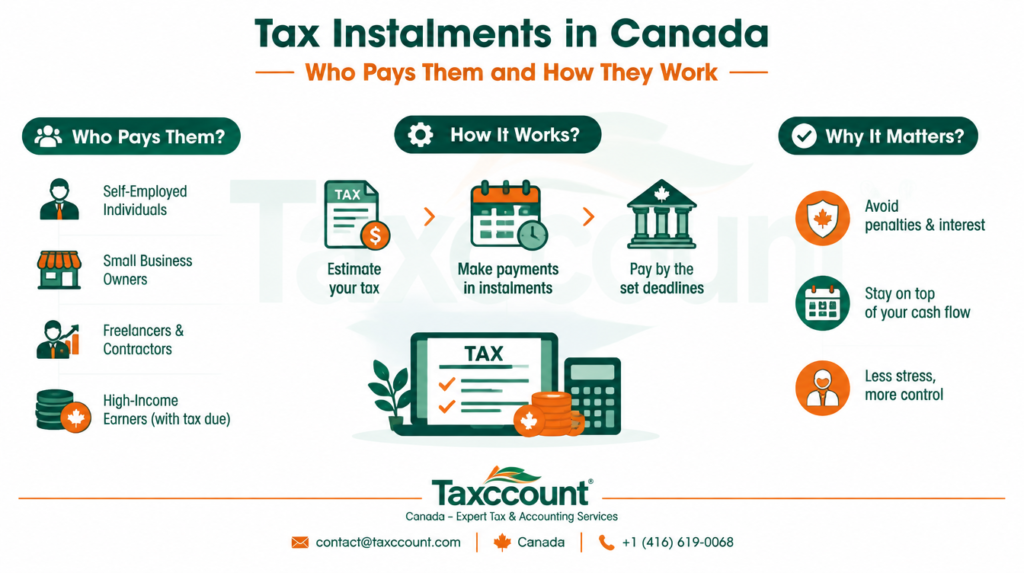
Tax instalments are periodic payments you make toward your expected tax bill for the year. Instead of paying everything at once when you file your return, you spread out the payments across the year.
This helps the government collect taxes more steadily throughout the year. It also helps you avoid a large lump-sum payment at tax time.
Let Taxccount review your situation
☎️ Get HelpWho Has to Pay Tax Instalments?
You are required to pay instalments if your net tax owing was more than $3,000 in either of the two previous years, and your tax for the current year is also expected to exceed $3,000.
For Quebec residents, the threshold is $1,800 because Quebec handles its own provincial income tax separately.
Common situations that trigger instalments:
1. Self-employment income
If you run your own business or work as a freelancer, no employer is withholding taxes for you. You are likely required to pay instalments.
2. Investment income
Large amounts of interest, dividends, or capital gains can trigger instalment requirements since these are not usually subject to payroll deductions.
3. Rental income
If you earn significant rental income and your tax owing is over the threshold, you may need to pay instalments.
4. Pension income
Retirees who receive CPP, OAS, and private pension income may have insufficient withholding, especially if they do not request deductions at source.
5. Commission-based employees
Some commission earners do not have enough tax withheld and may owe more than $3,000 at year end, triggering instalment requirements.
How Are Instalments Calculated?
The CRA offers three methods for calculating instalment payments:
Method 1: No-Calculation Option (using CRA reminders)
The CRA sends instalment reminders to people it expects will owe instalments. These reminders show the amounts based on your prior year tax owing. If you pay what the CRA tells you to, you will not be charged instalment interest or penalties, even if you owe more at year end.
Method 2: Prior Year Option
Pay the same total amount as your previous year’s net tax owing. Split this into four equal payments. This protects you from penalties as long as you match the prior year amount.
Method 3: Current Year Estimate Option
If you expect to earn less this year, you can estimate your current year income and pay based on that. If you underestimate and owe more at year end, the CRA will charge instalment interest on the shortfall.
When Are Instalments Due?
For individuals, tax instalment payments are due on:
- March 15
- June 15
- September 15
- December 15
For farmers and fishers, there is a single annual instalment due on December 31.
Self-employed individuals also follow the same quarterly schedule for personal taxes. Note that HST/GST instalments have a separate schedule.
How to Pay Tax Instalments
You can pay instalments in several ways:
1. Online banking: Set up the CRA as a payee through your bank’s online banking and make a payment to “CRA (Revenue) Tax Instalment.”
2. CRA My Account: You can make a payment directly through your CRA My Account using Interac Online or a pre-authorized debit arrangement.
3. My Payment: The CRA’s My Payment tool allows you to pay using a debit card online.
4. At your bank: You can pay in person at your financial institution using your CRA instalment remittance form.
5. By mail: Send a cheque payable to the Receiver General for Canada, along with your remittance form.
Always make sure your SIN is included with any payment.
What Happens If You Miss a Payment?
If you miss an instalment or pay less than required, the CRA charges instalment interest. The interest rate is the same prescribed rate charged on unpaid tax balances.
In addition, if your instalment interest for the year exceeds $1,000, the CRA may charge an instalment penalty on top of the interest.
The interest and penalty are calculated on the shortfall for each quarter, so the sooner you catch up, the less you owe.
If you also have a refund or overpayment in the year, that can offset some of the instalment interest owing.
Can You Reduce Your Instalment Amount?
Yes. If your income is lower than usual in a given year, you can calculate a reduced instalment based on your expected current-year income. However, you take on risk with this approach: if your actual income is higher than estimated, the CRA will charge interest on the underpayment.
You can also increase source deductions. If you have a job or receive a pension, you can request your employer or pension payer to withhold more tax per payment. This may eliminate or reduce the need for instalment payments.
Table of Summary
| Tax Instalments Topic | Key Information |
|---|---|
| What Are Tax Instalments? | Tax instalments are advance payments toward your expected annual tax bill, allowing you to pay throughout the year instead of making one large payment when filing your return. |
| Who Must Pay Instalments? | Individuals generally need to pay instalments if their net tax owing exceeded $3,000 in either of the two previous years and is expected to exceed $3,000 in the current year. |
| Quebec Residents | The instalment threshold is $1,800 for Quebec residents because Quebec administers its own provincial income tax separately. |
| Self-Employment Income | Freelancers and business owners may need to pay instalments when their tax owing meets the CRA threshold because income tax is not automatically withheld from their earnings. |
| Investment Income | Interest, dividends, and capital gains may trigger instalment requirements when they result in tax owing above the applicable threshold. |
| Rental Income | Individuals earning significant rental income may need to pay instalments if they meet the tax-owing criteria. |
| Pension Income | Retirees receiving CPP, OAS, or private pensions may need instalments if insufficient tax is withheld at source. |
| Commission-Based Employees | Employees earning commissions may need instalments if their tax deductions are insufficient and their tax owing meets the required threshold. |
| CRA Reminder Method | The CRA sends instalment reminders showing suggested payment amounts based on previous tax information. Following the applicable reminder amounts can help avoid instalment interest or penalties. |
| Prior-Year Method | Payments are based on the previous year’s net tax owing and divided into four instalments, according to the article’s explanation. |
| Current-Year Estimate Method | You can calculate instalments using your expected current-year income if you anticipate earning less. Underestimating income may result in instalment interest. |
| Quarterly Due Dates | Individual tax instalments are generally due on March 15, June 15, September 15, and December 15. |
| Farmers and Fishers | Farmers and fishers generally have a single annual instalment due on December 31. |
| Corporate Tax Instalments | Incorporated businesses also pay instalments, generally monthly under separate corporate tax rules. |
| Online Banking Payments | Add the CRA as a payee through your bank and select the appropriate tax instalment payment option. |
| CRA My Account and My Payment | Instalments can be paid through CRA My Account using available payment options or through the CRA My Payment service using a debit card. |
| Bank or Mail Payments | Payments can also be made at a financial institution using the remittance form or by mailing a cheque payable to the Receiver General for Canada. Include your SIN with payments as instructed in the article. |
| Missed Instalment Payments | Missing a payment or paying less than required can result in instalment interest on the shortfall. The interest rate is based on the CRA’s prescribed rate. |
| Instalment Penalty | If instalment interest for the year exceeds $1,000, the CRA may charge an additional instalment penalty. |
| Reducing Instalment Amounts | You can calculate reduced payments based on expected current-year income, but underestimating income may lead to interest charges. |
| Increasing Tax Withholding | Asking your employer or pension payer to deduct additional tax may reduce or eliminate the need for instalment payments. |
| Overpaid Instalments | Excess payments are credited to your CRA account and applied to your tax balance. If you pay more than you owe, the CRA generally issues a refund and may pay interest on instalment overpayments. |
| Professional Tax Assistance | A tax professional can help determine whether instalments are required, calculate appropriate payment amounts, and help minimize the risk of interest and penalties. |
Frequently Asked Questions
Do I have to pay instalments if I am self-employed?
Not automatically. You have to pay instalments only if your net tax owing exceeded $3,000 in either of the two previous tax years and is expected to again exceed $3,000 this year.
Will the CRA tell me I have to pay instalments?
The CRA sends instalment reminder letters to people it believes need to pay. However, the obligation exists whether or not you receive a reminder. You are responsible for making the payments if you meet the criteria.
What if I pay too much in instalments?
If you overpay, the excess is credited to your account and applied to your balance when you file. If you overpaid more than you owe, the CRA issues a refund. The CRA pays interest on instalment overpayments.
Do incorporated businesses pay instalments too?
Yes, but under different rules. Corporations pay monthly corporate tax instalments. This guide focuses on personal income tax instalments for individuals.
Conclusion
Tax instalments are a way to pay your taxes gradually throughout the year instead of in one large payment at filing time. If you earn self-employment income, rental income, investment income, or any other income without automatic tax deductions, you may be required to pay quarterly instalments.
Paying on time and in the right amount avoids interest and penalties. When in doubt, use the CRA reminder amounts or work with a tax professional to calculate the right instalment amounts for your situation.
How Taxccount Canada Can Help
Tax instalments can be difficult to estimate when your income changes from year to year or comes from several sources. Incorrect estimates can create cash-flow challenges and potentially lead to CRA interest charges.
Taxccount Canada can help individuals and business owners review their income, estimate tax liabilities, understand instalment requirements, and organize their tax records. If you are unsure which calculation option applies to you, professional guidance can help you make informed decisions.
Contact Taxccount Canada to book a free consultation and discuss your tax planning and accounting needs.
Book a free consultation with Taxccount today
☎️ Get HelpThis is general information only and not professional advice. Consult a professional before acting.
 Written and fact-checked by Udit Gupta
 Written and fact-checked by
 Ex Big4, Ernst & Young, Deloitte | International & Cross-Border Tax Specialist | CPA Canada In Depth Tax Training | Licensed Chartered Accountant from ICAI & MIA
Udit Gupta has over 15 years of experience helping corporations & business owners with corporate structuring, corporate tax filing, bookkeeping, payroll, GST/HST, cross-border tax and CRA representation. Big 4 trained at Ernst & Young and Deloitte, and qualified as a Chartered Accountant in India and Malaysia, he founded accounting firm in 2014 to serve entrepreneurs, startups and non-resident business owners across Canada. View Full Member Bio.
Indian Institute of Chartered Accountant Member No. (521458) | Malaysian Institute of Accountants Membership number (CA 44667) | Ex Big4,Ex Ernst & Young (EY), Ex-Deloitte | CPA Canada In-Depth Tax Training 19 Dec 2023, 12 Jul 2022, 5 Jul 2023
Editorial policy. Every article is researched against primary sources — the Income Tax Act, CRA publications and CPA Canada.