Can You Gift Money Tax-Free in Canada?

In many countries, giving or receiving a large gift of cash triggers a tax bill. If you are looking to give money to family or friends in Canada, you might be worried about a “gift tax.” However, the rules in Canada are very different — and generally much more favourable for both the giver and the recipient.
This guide by Taxccount Canada explains gifting rules clearly for individuals seeking tax filing near me support.
Is There a Gift Tax in Canada?
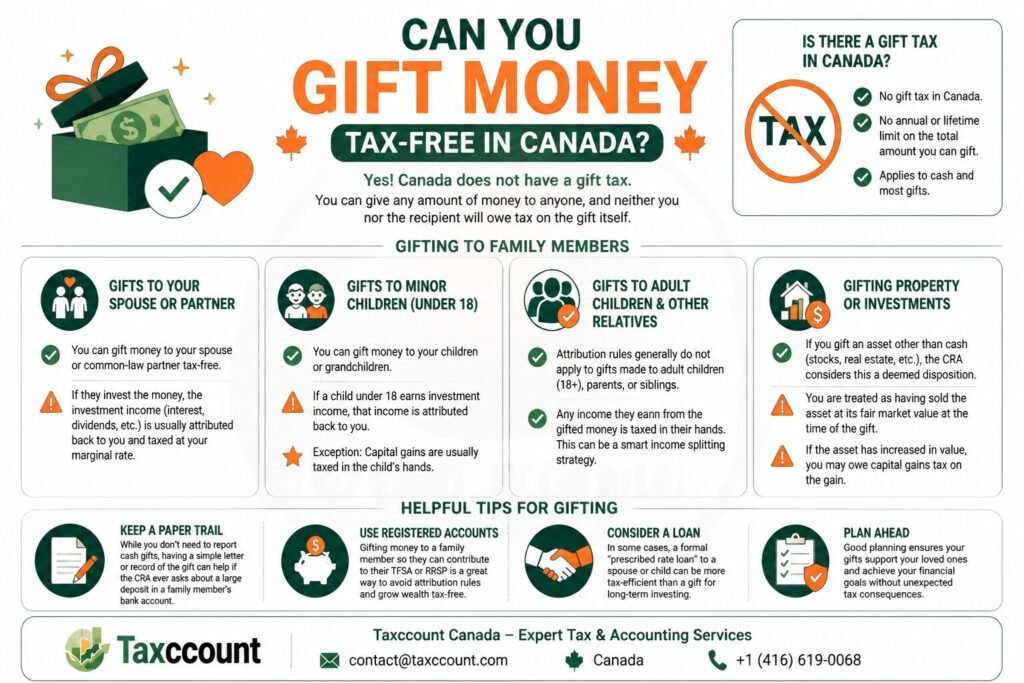
No. Canada does not have a gift tax. You can give any amount of money to anyone — a spouse, a child, a parent, or a friend — and neither you nor the recipient will owe tax on the gift itself. There is also no annual or lifetime limit on the total amount you can gift.
For better tax planning, many individuals use tax and accounting services to understand related implications.
Gift Money Smartly
☎️ Get HelpGifting to Family Members
While the gift itself is tax-free, the CRA has “attribution rules” to prevent people from shifting income-earning assets to family members in lower tax brackets.
This is important during tax return filing services.
Gifts to Your Spouse or Partner
You can gift money to your spouse or common-law partner tax-free. However, if they invest that money, the investment income (interest, dividends, or rental income) earned on that gift is usually attributed back to you and taxed at your marginal rate.
Consulting an accountant for taxes can help you understand attribution rules.
Gifts to Minor Children (Under 18)
You can gift money to your children or grandchildren. Similar to spouses, if a child under 18 earns investment income from your gift, that income is attributed back to you.
One exception is capital gains — if the child sells an asset for a profit, the gain is usually taxed in the child’s hands, not yours.
An income tax chartered accountants expert can help with planning.
Gifts to Adult Children and Other Relatives
Attribution rules generally do not apply to gifts made to adult children (18+), parents, or siblings. Any income they earn from the gifted money is taxed in their hands, making this a common strategy for family income splitting.
This strategy is often discussed with a tax accountant Toronto professional.
Gifting Property or Investments
If you gift an asset other than cash (such as stocks or real estate), the CRA considers this a deemed disposition. You are treated as having sold the asset at its fair market value at the time of the gift. If the asset has increased in value, you may owe capital gains tax on the difference between the original cost and the market value.
A tax accountant near me can help calculate these gains correctly.
Helpful Tips for Gifting
Keep a Paper Trail
While you don’t need to report cash gifts, having a simple letter or record of the gift can help if the CRA ever asks about a large deposit in a family member’s bank account.
Proper records simplify tax filing.
Use Registered Accounts
Gifting money to a family member so they can contribute to their TFSA or RRSP is a great way to avoid attribution rules.
This strategy is often advised by a small business accountant.
Consider a Loan
In some cases, a formal “prescribed rate loan” to a spouse or child can be more tax-efficient than a gift for long-term investing.
This is where a taxation accountant may provide better long-term planning.
Table of Content
Here is the blog information in 6 easy rows for quick understanding:
| Section | Easy Information |
|---|---|
| 1. Topic | The blog explains whether you can gift money tax-free in Canada and how CRA treats gifts. |
| 2. Gift Tax Rule | Canada has no gift tax. You can give any amount to anyone without tax on the gift itself. |
| 3. Attribution Rules | Income earned from gifted money may be taxed back to the giver in some cases (spouse or minor children). |
| 4. Family Rules | Spouse/minor children: investment income may be attributed back to giver. Adult children: income is taxed in their hands. |
| 5. Gifting Assets | Non-cash gifts (stocks/real estate) trigger deemed disposition, meaning capital gains tax may apply at fair market value. |
| 6. Smart Strategies | Keep records, use TFSA/RRSP gifting strategies, or structured loans to reduce tax impact legally. |
Frequently Asked Questions
Can Tax Filing Near Me Services Help With Large Cash Gifts in Canada?
Yes. A tax professional can explain whether a large cash gift has any related reporting, attribution, or tax-planning considerations for your situation.
Do Tax and Accounting Services Help With Gifts to a Spouse?
Yes. Gifts to a spouse are tax-free, but investment income earned from the gifted money may be attributed back to the giver for tax purposes.
Are Tax Return Filing Services Needed for Cash Gifts?
Cash gifts generally do not need to be reported as taxable income by the recipient, but proper records are helpful for large transfers.
Should I Speak With an Accountant for Taxes Before Gifting Property?
Yes. Gifting property, shares, or investments may trigger capital gains tax because the CRA treats the transfer as a sale at fair market value.
Can a Tax Accountant Near Me Help With Family Gifting Strategies?
Yes. A tax accountant can help structure gifts, TFSA contributions, RRSP funding, or prescribed rate loans in a tax-efficient way.
Avoid Gift Tax Issues
☎️ Get HelpThis is general information only and not professional advice. Consult a professional before acting.
 Written and fact-checked by Udit Gupta
 Written and fact-checked by
 Ex Big4, Ernst & Young, Deloitte | International & Cross-Border Tax Specialist | CPA Canada In Depth Tax Training | Licensed Chartered Accountant from ICAI & MIA
Udit Gupta has over 15 years of experience helping corporations & business owners with corporate structuring, corporate tax filing, bookkeeping, payroll, GST/HST, cross-border tax and CRA representation. Big 4 trained at Ernst & Young and Deloitte, and qualified as a Chartered Accountant in India and Malaysia, he founded accounting firm in 2014 to serve entrepreneurs, startups and non-resident business owners across Canada. View Full Member Bio.
Indian Institute of Chartered Accountant Member No. (521458) | Malaysian Institute of Accountants Membership number (CA 44667) | Ex Big4,Ex Ernst & Young (EY), Ex-Deloitte | CPA Canada In-Depth Tax Training 19 Dec 2023, 12 Jul 2022, 5 Jul 2023
Editorial policy. Every article is researched against primary sources — the Income Tax Act, CRA publications and CPA Canada.