How Much Tax Refund Can I Get in Canada?
Getting a tax refund feels great — but many Canadians either leave money on the table or make it bigger than it needs to be. Understanding how a refund is calculated and what factors affect its size can help you make smarter financial decisions all year long.
Taxccount Canada helps individuals searching for tax filing near me understand how tax refunds are calculated and how to maximize eligible claims.
What Is a Tax Refund?
When your employer deducts income tax from each paycheque, they estimate how much tax you will owe for the full year. If those deductions add up to more than your actual tax owing based on your final return, the CRA sends you the difference as a refund.
Professional tax return filing services can help ensure your refund is calculated accurately.
Maximize Your Tax Refund
☎️ Get HelpWhat Determines How Much Refund You Get?
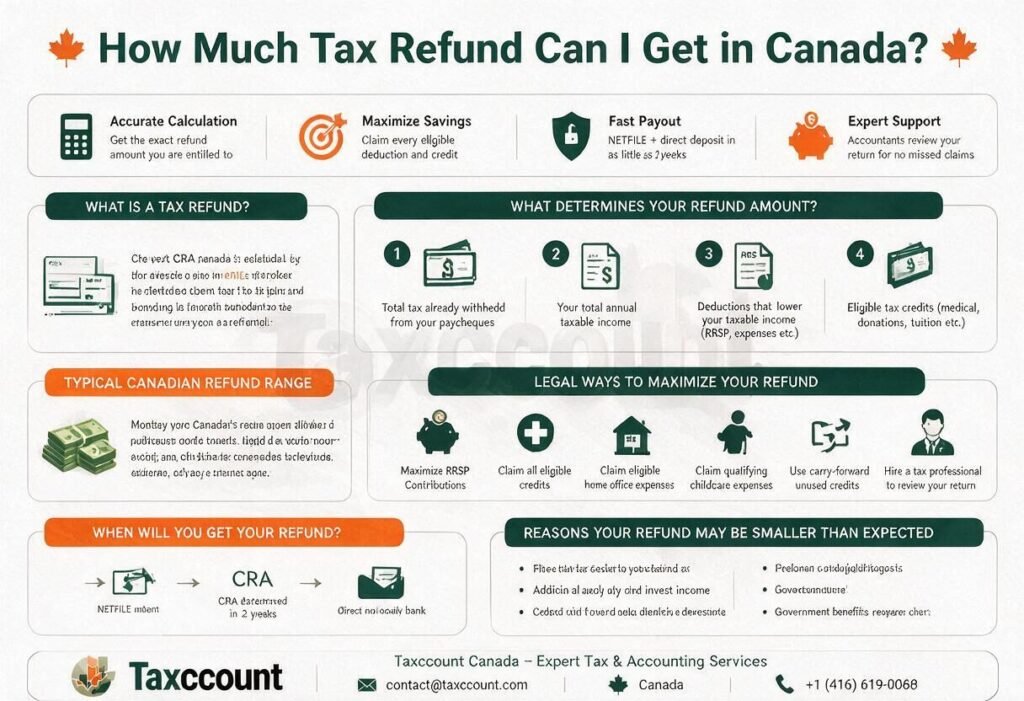
Your refund depends on several factors:
- How much tax was withheld from your paycheque during the year
- Your actual total income for the year
- Deductions that reduce your taxable income (like RRSP contributions)
- Tax credits you are entitled to (medical expenses, charitable donations, tuition, etc.)
An accountant for taxes can review your return to ensure you have claimed every eligible deduction and credit.
How Much Do Canadians Usually Get Back?
The average Canadian tax refund varies each year. Generally, most refunds fall in the range of a few hundred to a few thousand dollars. People who tend to receive larger refunds include:
- Those who made significant RRSP contributions during the tax year
- Those with large medical expenses or charitable donations
- Those who worked only part of the year
- Those who changed jobs mid-year or had irregular income
Every taxpayer’s refund is unique because it depends on income, deductions, credits, and taxes already paid.
How to Maximize Your Tax Refund
There are several legal ways to increase your refund or reduce what you owe.
Maximize RRSP Contributions
Every dollar contributed reduces your taxable income, which may lower your tax owing and increase your refund.
Claim All Eligible Credits
Medical expenses, charitable donations, tuition, and other eligible credits can reduce your tax payable.
Claim Home Office Expenses
If you work from home and meet the CRA requirements, you may be able to deduct a portion of your eligible home office expenses.
Claim Childcare Expenses
Daycare, babysitters, and other qualifying childcare costs may be deductible if you meet the eligibility rules.
Check for Carry-Forward Amounts
Unused RRSP contribution room and tuition credits from previous years may help reduce your taxes.
Tax accountants can help identify deductions and credits that are commonly overlooked.
When Will You Receive Your Refund?
If you file online through NETFILE, the CRA typically processes your return within two weeks. Registering for direct deposit ensures your refund arrives quickly and securely in your bank account.
Income tax preparation near me services can help you file accurately and avoid delays in receiving your refund.
Why Your Refund May Be Smaller Than Expected
Several factors can reduce your refund or result in a balance owing, including:
- Insufficient tax withheld during the year
- Additional employment or self-employment income
- Investment or rental income
- Reduced deductions or tax credits compared to previous years
- Repayment obligations for certain government benefits
If your tax situation has changed, tax and accounting services can help explain why your refund differs from previous years.
Table of Summary
Here is the blog information in 6 easy rows for quick understanding:
| Section | Easy Information |
|---|---|
| 1. Topic | The blog explains how tax refunds work in Canada and what determines the amount you get back. |
| 2. What a Tax Refund Is | If more tax was withheld from your paycheques than you owe, CRA sends the difference back as a refund. |
| 3. Factors Affecting Refund | Refund depends on tax withheld, total income, deductions (e.g., RRSP), and tax credits (medical, tuition, charitable donations). |
| 4. Who Gets Larger Refunds | People with significant RRSP contributions, high medical or donation expenses, partial-year work, or mid-year job changes tend to receive bigger refunds. |
| 5. How to Maximize Refund | Contribute to RRSPs, claim all eligible credits, deduct home office and childcare expenses, and use carry-forward amounts from previous years. |
| 6. Timing & Reasons Refund May Differ | Online NETFILE refunds arrive in ~2 weeks with direct deposit. Refunds may be smaller due to insufficient withholding, extra income, reduced deductions/credits, or repayment obligations. |
Frequently Asked Questions
Can Tax Filing Near Me Services Help Estimate My Tax Refund?
Yes. Tax filing near me services can review your income, tax withheld, deductions, and credits to estimate whether you may receive a refund.
Do Tax Return Filing Services Help Maximize Refunds in Canada?
Yes. Tax return filing services can help identify eligible RRSP deductions, medical expenses, donations, tuition credits, childcare costs, and other claims.
Can an Accountant for Taxes Explain Why My Refund Is Lower?
Yes. An accountant for taxes can review income changes, payroll deductions, self-employment income, benefits repayment, and missed credits that may reduce your refund.
Do Tax Accountants Help With RRSP Refund Planning?
Yes. Tax accountants can help calculate how RRSP contributions may reduce taxable income and potentially increase your refund.
Can Income Tax Preparation Near Me Services Help Me Get My Refund Faster?
Yes. Income tax preparation near me services can help you file online, set up direct deposit, and reduce filing errors that may delay processing.
Can Tax and Accounting Services Help If I Owe Instead of Getting a Refund?
Yes. Tax and accounting services can explain why you have a balance owing and help plan deductions, instalments, or payroll withholding for future years.
Should I Contact a Tax Accountant Near Me Before Filing?
Yes. A tax accountant near me can review your slips, receipts, carry-forward amounts, and credits before filing to help ensure your return is accurate.
Claim Every Eligible Credit
☎️ Get HelpThis is general information only and not professional advice. Consult a professional before acting.
 Written and fact-checked by Udit Gupta
 Written and fact-checked by
 Ex Big4, Ernst & Young, Deloitte | International & Cross-Border Tax Specialist | CPA Canada In Depth Tax Training | Licensed Chartered Accountant from ICAI & MIA
Udit Gupta has over 15 years of experience helping corporations & business owners with corporate structuring, corporate tax filing, bookkeeping, payroll, GST/HST, cross-border tax and CRA representation. Big 4 trained at Ernst & Young and Deloitte, and qualified as a Chartered Accountant in India and Malaysia, he founded accounting firm in 2014 to serve entrepreneurs, startups and non-resident business owners across Canada. View Full Member Bio.
Indian Institute of Chartered Accountant Member No. (521458) | Malaysian Institute of Accountants Membership number (CA 44667) | Ex Big4,Ex Ernst & Young (EY), Ex-Deloitte | CPA Canada In-Depth Tax Training 19 Dec 2023, 12 Jul 2022, 5 Jul 2023
Editorial policy. Every article is researched against primary sources — the Income Tax Act, CRA publications and CPA Canada.