What Is an Income Tax Return in Canada? A Clear Explanation

If you are new to filing taxes in Canada, the term income tax return can be confusing. Is it the same as a refund? Is it something you submit or something you receive? This guide explains exactly what an income tax return is, why you file one, and what happens after you do.
What Is an Income Tax Return?
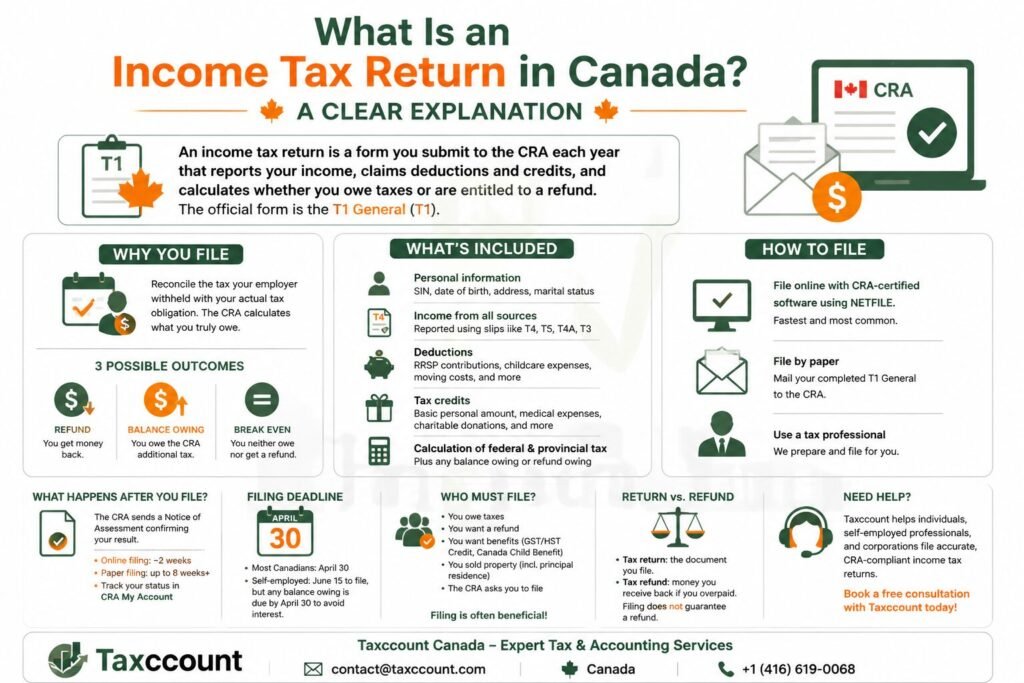
An income tax return is a form you submit to the Canada Revenue Agency each year that reports your total income, claims any deductions and credits, and calculates whether you owe taxes or are entitled to a refund. Filing your return is how the CRA determines your final tax obligation for the year.
The official form for individual Canadians is called the T1 General, commonly referred to as the T1. Each province also has its own provincial tax portion, which is included in the same return.
File Your Tax Return
☎️ Get HelpWhy You File an Income Tax Return
Throughout the year, your employer deducts income tax from your paycheques based on an estimate of what you will owe. At tax time, you file a return to reconcile that estimate with your actual tax obligation. The CRA uses the information you provide to calculate how much you truly owe based on all your income, deductions, and credits.
The result is one of three outcomes:
- You get a refund if more tax was withheld than you owe
- You owe a balance if less was withheld than you owe
- You break even if the amount withheld matches exactly what you owe
What Is Included in an Income Tax Return?
A Canadian income tax return includes the following sections:
- Your personal information, including your SIN, date of birth, address, and marital status
- Your total income from all sources, reported using tax slips such as T4, T5, T4A, and T3
- Deductions you are claiming, such as RRSP contributions, childcare expenses, and moving costs
- Tax credits you are eligible for, including the basic personal amount, medical expenses, and charitable donations
- The calculation of federal and provincial tax owing
- Any balance owing or refund owing based on the above
How Do You File an Income Tax Return in Canada?
Most Canadians file their income tax return electronically using CRA-certified tax software through the CRA’s NETFILE service. This is the fastest and most common method. You can also file by paper by mailing your completed T1 General to the CRA, or you can have a tax professional prepare and file on your behalf.
What Happens After You File?
Once the CRA processes your return, it sends a Notice of Assessment that confirms whether you have a refund, a balance owing, or no change. If you filed online, processing takes approximately two weeks. Paper returns can take up to eight weeks or longer. You can track the status of your return through CRA My Account.
What Is the Filing Deadline?
The income tax return deadline for most Canadians is April 30 each year. Self-employed individuals and their spouses have until June 15 to file, but any balance owing must still be paid by April 30 to avoid interest. Filing late when you owe taxes results in a late-filing penalty.
Who Must File an Income Tax Return in Canada?
You must file if you owe taxes, want a refund, want to access benefits like the GST/HST Credit or Canada Child Benefit, sold property including a principal residence, or the CRA has asked you to file. Even if none of these apply, filing a return is often beneficial because many government benefits are unlocked only when you file.
Common Questions About Income Tax Returns
Many Canadians confuse an income tax return with a tax refund. A tax return is the document you file. A tax refund is money you receive back if you overpaid. Filing a tax return does not automatically mean you will receive a refund.
Need Help Filing Your Income Tax Return?
Taxccount provides professional tax filing support for individuals, self-employed Canadians, and corporations, helping them prepare accurate returns that meet CRA requirements. Whether you are submitting your first tax return or dealing with a more complicated tax situation, our experienced Canadian tax team can guide you through the process. Book a free consultation with Taxccount today.
Table of Summary
Here is the blog information in 6 easy rows for quick understanding:
| Section | Easy Information |
|---|---|
| 1. Topic | The blog explains what an income tax return is in Canada and why you file one. |
| 2. Definition | An income tax return (T1 General) reports all income, deductions, and credits to the CRA to determine taxes owed or refund. |
| 3. Purpose | Reconciles tax withheld by your employer with your actual tax obligation, resulting in a refund, balance owing, or break-even. |
| 4. Contents | Includes personal info (SIN, DOB, marital status), total income (T4, T5, T3 slips), deductions (RRSP, childcare, moving), credits (basic personal amount, medical, charitable), and tax calculation. |
| 5. Filing Methods | File online via CRA-certified software (NETFILE), paper T1 return, or through a tax professional. |
| 6. Deadlines & After Filing | Most Canadians: April 30; self-employed: June 15 to file but payment due April 30. CRA sends a Notice of Assessment confirming refund or balance owing. |
Frequently Asked Questions
Is an income tax return the same as a tax refund?
No. An income tax return is the form you file with the CRA. A tax refund is the money you receive back if you overpaid your taxes during the year. You file a return to determine whether you get a refund, owe a balance, or break even.
What is the T1 General?
The T1 General is the official name for the Canadian personal income tax return form. It is the document most individual Canadians complete and submit to the CRA each year, either online or by paper.
Do I have to file an income tax return if I had no income?
You are not always legally required to file if you had no income and owe no taxes. However, filing is often worth doing because it can make you eligible for refundable credits and government benefits such as the GST/HST Credit and the Canada Carbon Rebate.
How long should I keep my income tax returns?
The CRA recommends keeping records related to your income tax return for at least six years, as this is the period during which you may be subject to a CRA review or audit.
Ready to File Your Income Tax Return With Confidence?
Filing your income tax return does not have to be complicated. Taxccount’s Canadian tax professionals ensure your return is complete, accurate, and filed on time. Book a free consultation with Taxccount today and take the stress out of tax season.
Get Income Tax Help
☎️ Get HelpThis is general information only and not professional advice. Consult a professional before acting.
 Written and fact-checked by Udit Gupta
 Written and fact-checked by
 Ex Big4, Ernst & Young, Deloitte | International & Cross-Border Tax Specialist | CPA Canada In Depth Tax Training | Licensed Chartered Accountant from ICAI & MIA
Udit Gupta has over 15 years of experience helping corporations & business owners with corporate structuring, corporate tax filing, bookkeeping, payroll, GST/HST, cross-border tax and CRA representation. Big 4 trained at Ernst & Young and Deloitte, and qualified as a Chartered Accountant in India and Malaysia, he founded accounting firm in 2014 to serve entrepreneurs, startups and non-resident business owners across Canada. View Full Member Bio.
Indian Institute of Chartered Accountant Member No. (521458) | Malaysian Institute of Accountants Membership number (CA 44667) | Ex Big4,Ex Ernst & Young (EY), Ex-Deloitte | CPA Canada In-Depth Tax Training 19 Dec 2023, 12 Jul 2022, 5 Jul 2023
Editorial policy. Every article is researched against primary sources — the Income Tax Act, CRA publications and CPA Canada.