Do I Pay Property Tax in Canada? Everything You Need to Know
If you own a home or any kind of real estate in Canada, property tax is something you will deal with every single year. Yet many Canadians are unclear about how it works, how it is calculated, and what happens if they miss a payment. This guide explains everything in plain language.
What Is Property Tax?
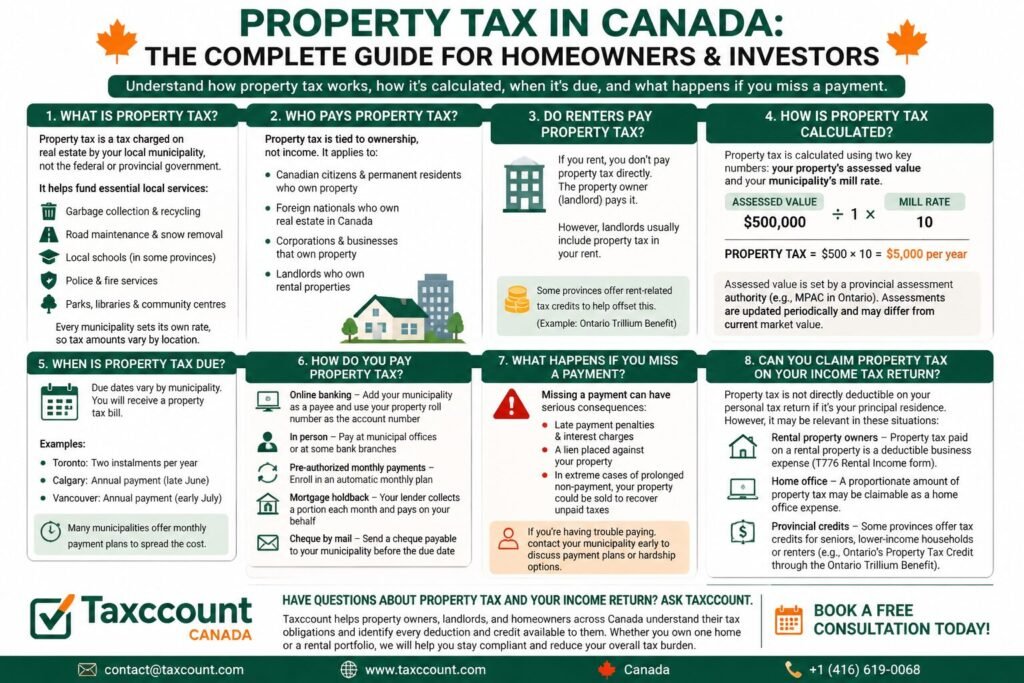
Property tax is a tax charged on real estate. It applies to homes, condos, commercial buildings, and land. In Canada, property tax is collected by your local municipality, not by the federal or provincial government.
The money raised from property taxes funds essential local services such as:
- Garbage collection and recycling
- Road maintenance and snow removal
- Local schools (in some provinces)
- Police and fire services
- Parks, libraries, and community centres
Every municipality in Canada sets its own property tax rate, which is why rates vary significantly from one city or town to another.
File Taxes With Confidence
☎️ Get HelpWho Pays Property Tax?
If you own real estate in Canada, you pay property tax. It is tied to ownership, not to how much you earn. This means it applies to:
- Canadian citizens and permanent residents who own property
- Foreign nationals who own real estate in Canada
- Corporations and businesses that own property
- Landlords who own rental properties
Do Renters Pay Property Tax?
If you rent your home, you do not pay property tax directly. Property tax is the responsibility of the property owner (your landlord). However, renters often pay property tax indirectly — landlords typically factor it into the rent they charge.
Some provinces offer rent-related tax credits to help offset this. In Ontario, for example, renters may be eligible for the Ontario Trillium Benefit, which includes a component to assist with property tax paid indirectly through rent.
How Is Property Tax Calculated?
Property tax is calculated using two key numbers: your property’s assessed value and your municipality’s mill rate.
Property Tax = (Assessed Value ÷ 1,000) × Mill Rate
For example, if your home is assessed at $500,000 and your municipality has a mill rate of 10, your annual property tax would be:
($500,000 ÷ 1,000) × 10 = $5,000 per year
Your property’s assessed value is determined by a provincial assessment authority — for example, MPAC (Municipal Property Assessment Corporation) in Ontario. Assessments are typically updated periodically and may not always match current market values.
When Is Property Tax Due?
Property tax due dates vary by municipality. Your local government will send you a property tax bill. Common billing structures include:
- Toronto — Two instalments per year
- Calgary — Annual payment typically in late June
- Vancouver — Annual payment typically in early July
Many municipalities also offer monthly payment plans so you can spread the cost throughout the year rather than paying one large sum.
How Do You Pay Property Tax?
Common methods to pay your property tax include:
- Online banking — Add your municipality as a payee and use your property roll number as the account number
- In person — Pay at municipal offices or at some bank branches
- Pre-authorized monthly payments — Many municipalities allow you to enroll in an automatic monthly payment plan
- Mortgage holdback — Some mortgage lenders collect a portion of property tax each month as part of your mortgage payment, then pay the municipality on your behalf
- Cheque by mail — Send a cheque payable to your municipality before the due date
What Happens If You Miss a Property Tax Payment?
Missing a property tax payment can have serious consequences. Depending on your municipality, you may face:
- Late payment penalties and interest charges
- A lien placed against your property
- In extreme cases of prolonged non-payment, the municipality may take steps to sell the property to recover unpaid taxes
If you are having difficulty making payments, contact your municipality early to discuss options such as a deferred payment plan or other hardship provisions.
Can You Claim Property Tax on Your Income Tax Return?
Property tax is not directly deductible on your federal T1 personal income tax return if the property is your principal residence. However, there are some situations where property tax may be relevant for tax purposes:
- Rental property owners — Property tax paid on a rental property is a deductible business expense on your T776 Rental Income form
- Home office — If you work from home, a proportionate amount of property tax may be claimable as a home office expense
- Provincial credits — Some provinces offer tax credits related to property taxes for seniors, lower-income households, or renters. Ontario’s Property Tax Credit (through the Ontario Trillium Benefit) is one example
Have Questions About Property Tax and Your Income Return? Ask Taxccount
Taxccount helps property owners, landlords, and homeowners across Canada understand their tax obligations and identify every deduction and credit available to them. Whether you own one home or a rental portfolio, we will help you stay compliant and reduce your overall tax burden. Book a free consultation with Taxccount today.
Table of Summary
Here is the blog information in 6 easy rows for quick understanding:
| Section | Easy Information |
|---|---|
| 1. Topic | The blog explains property tax in Canada, including who pays it, how it is calculated, and consequences of missing payments. |
| 2. Who Pays | Property owners pay tax, including Canadian citizens, permanent residents, foreign nationals, corporations, and landlords. Renters do not pay directly, but may contribute indirectly via rent. |
| 3. How Calculated | Property tax = (Assessed Value ÷ 1,000) × Mill Rate. Assessed value is determined by provincial assessment authorities (e.g., MPAC in Ontario). |
| 4. Payment Methods | Pay via online banking, in person, pre-authorized payments, mortgage holdback, or cheque by mail. |
| 5. Missed Payment Consequences | Late fees, interest, property lien, and in extreme cases, municipal sale of the property. Contact your municipality early if struggling. |
| 6. Tax Relevance | Property tax is generally not deductible on your federal T1 return for your principal residence, but may be deductible for rental properties or home office; provincial credits may also apply. |
Frequently Asked Questions
Is property tax the same as income tax in Canada?
No. Income tax is charged by the federal and provincial governments on money you earn. Property tax is charged by your local municipality on the value of real estate you own. They are completely separate taxes with different rates and rules.
Do non-residents pay property tax in Canada?
Yes. If you own property in Canada, you owe property tax regardless of your residency status. Non-residents who own Canadian real estate are also subject to the federal Underused Housing Tax (UHT) if the property is vacant or underused.
Can I appeal my property tax assessment?
Yes. If you believe your property has been incorrectly assessed, you can file a formal appeal with your provincial assessment authority. In Ontario, this is done through MPAC’s Request for Reconsideration process. Deadlines and procedures vary by province.
Does my property tax go to the federal government?
No. Property tax is collected and retained by your local municipality. It does not go to the federal government or the provincial government (though some provinces receive a portion of education-related property tax levies).
Get Expert Tax Help
☎️ Get HelpOfficial CRA Source
- Who May Owe Tax / Taxable Income – CRA – Do You Have to File a Tax Return?
- Income Tax Payment Deadline – CRA – Payment Deadlines for Individuals
- Ways to Pay CRA – Ways to Pay Your Income Tax
- Pre-Authorized Debit (PAD) – CRA – Pre-Authorized Debit (PAD) Agreement
- CRA My Payment– CRA My Payment
- Late Payment / Interest & Penalties – CRA – Penalties and Interest
- Self-Employed Instalments – CRA – Instalments for Individuals
- Overpayment / Refunds – CRA
- My Account Online Service – CRA
This is general information only and not professional advice. Consult a professional before acting.
 Written and fact-checked by Udit Gupta
 Written and fact-checked by
 Ex Big4, Ernst & Young, Deloitte | International & Cross-Border Tax Specialist | CPA Canada In Depth Tax Training | Licensed Chartered Accountant from ICAI & MIA
Udit Gupta has over 15 years of experience helping corporations & business owners with corporate structuring, corporate tax filing, bookkeeping, payroll, GST/HST, cross-border tax and CRA representation. Big 4 trained at Ernst & Young and Deloitte, and qualified as a Chartered Accountant in India and Malaysia, he founded accounting firm in 2014 to serve entrepreneurs, startups and non-resident business owners across Canada. View Full Member Bio.
Indian Institute of Chartered Accountant Member No. (521458) | Malaysian Institute of Accountants Membership number (CA 44667) | Ex Big4,Ex Ernst & Young (EY), Ex-Deloitte | CPA Canada In-Depth Tax Training 19 Dec 2023, 12 Jul 2022, 5 Jul 2023
Editorial policy. Every article is researched against primary sources — the Income Tax Act, CRA publications and CPA Canada.